How Should Cheating Be Defined In Sports?


When Milwaukee Brewers pitcher Chris Capuano reports for spring training in April, he will be anxious to demonstrate the effects of a performance-enhancing off-season. His brain will benefit from a sharper focus while his throwing arm will boast an extra boost that has been missing since 2006. Stimulants? Steroids? Scandal? No need to panic, he just had LASIK surgery for his eyes and "Tommy John" surgery for his injured elbow. Of course, had he chosen amphetamines to improve his focus or steroids to increase his strength, he would have been banned and berated. 

Society Decides
There is confusion over the means and methods athletes have available to enhance their performance. Certainly, corrective eye surgery to raise your vision level to 20/20 seems fair, but many athletes go into the procedure hoping to come out with enhanced 20/15 or 20/10 eyesight. Replacing a damaged elbow ligament with a tendon doesn't seem like cheating, but what if its done on a healthy elbow hoping for a few more miles per hour on a fastball that has faded over the years?

Earlier this month, a commentary in the journal Nature recommended a fresh look at cognitive-enhancing drugs and where to draw the line in the sand between natural performance and enhanced performance. The authors, an esteemed group of neuroscientists and ethicists, argued that "enhanced" is only defined by the rules set by society.

Certainly, abuse of prescription drugs, such as Ritalin and Adderall, is illegal because of the potential, harmful side effects. Still, reports of the rising use of these drugs by college students and professionals show the demand for options beyond nutrition, exercise and sleep.
These drugs are just the first generation of possible brain boosting supplements, which is why the Nature commentators are calling for an organized, stigma-free approach to evaluating the risks, benefits and ethics of future products.

Even in Major League Baseball, there is mounting evidence that cognitive-enhancing drugs may be on the rise. Since MLB banned amphetamines in 2006, there has been a dramatic rise in the number of therapeutic use exemptions issued to players for attention-deficit disorder diagnoses, for which drugs like Ritalin and Adderall can be legitimately prescribed. In 2006, 28 players applied for the exemption, while a year later there were 103. There is suspicion that many of these ADD diagnoses are just excuses to get the pills.


Legal Jolt

So, what if there was a cognitive-enhancing, sports supplement that increased alertness, concentration, reaction time and focus while also decreasing the perception of muscle fatigue? Even more encouraging, this supplement is sold in millions of outlets and is socially accepted worldwide. It comes in three sizes, tall, grande or venti – coffee. More specifically, caffeine has been the subject of many recent studies of its effectiveness, both cognitively and physiologically.

Earlier this year, Dr. Carrie Ruxton completed a literature survey to summarize 41 double-blind, placebo-controlled trials published over the past 15 years to establish what range of caffeine consumption would maximize benefits and minimize risk for cognitive function, mood, physical performance and hydration. The studies were divided into two categories, those that looked at the cognitive effects and those that looked at physical performance effects.
The results concluded that there was a significant improvement in cognitive functions like attention, reaction time and mental processing as well as physical benefits described as increased "time to exhaustion" and decreased "perception of fatigue" in cycling and running tests.

Given these results, how exactly does caffeine perform these wonderful tricks? Dr. Ruxton explains from the study, "Caffeine is believed to impact on mood and performance by inhibiting the binding of both adenosine and benzodiazepine receptor ligands to brain membranes. As these neurotransmitters are known to slow down brain activity, a blockade of their receptors lessens this effect."
Bottom line, the chemicals in your brain that would cause you to feel tired are blocked, giving you a feeling of ongoing alertness. This pharmacological process is very similar to that of the ADD drugs.

If caffeine is such a clear cut performance enhancing supplement, why did the World Anti-Doping Agency (WADA) first add caffeine to its banned substance list, only to remove it in 2004? At the time that it was placed on the banned list, the threshold for a positive caffeine test was set to a post-exercise urinary caffeine concentration of about 3-4 cups of strong coffee.
However, more recent research has shown that caffeine has ergogenic effects at levels as low as the equivalent of 1-2 cups of coffee. So, it was hard for WADA to know where to draw the line between athletes just having a few morning cups of coffee/tea and those that were intentionally consuming caffeine to increase their performance level.

So, if Chris Capuano has a double espresso before pitching, his brain, eyes and arm should enhance his performance in the game.  Is that an unfair advantage? Science will continue to offer new and improved methods for raising an athlete's game above the competition. Players, league officials and fans will have to decide where to draw the line.

Please visit my other articles on Livescience.com

Athletic Gene ACTN3 = "All Children Test Newborn To 3"?


Of all of the decisions parents face regarding their children's future, choosing between shoulder pads or running shoes for their Christmas present seems trivial. Well, according to Kevin Reilly, president of Atlas Sports Genetics, this is a decision you should not take lightly.
"If you wait until high school or college to find out if you have a good athlete on your hands, by then it will be too late," he said in a recent New York Times interview. "We need to identify these kids from 1 and up, so we can give the parents some guidelines on where to go from there."

Earlier this month, Reilly's company began marketing a $149 saliva swab test for kids, aged 1 to 8, to determine which variant of the gene ACTN3 is in their DNA. According to a 2003 Australian study, ACTN3 was shown to be a marker for two different types of athletic prowess, explosive power or long endurance. While everyone carries the gene, the combination of variants inherited, one from each parent, differs.

Science of success
The R variant of ACTN3 signals the body to produce a protein, alpha-actinin-3, which is found exclusively in fast-twitch muscles. The X variant prohibits this production. So, athletes inheriting two R variants may have a genetic advantage in sports requiring quick, powerful muscle contractions from their fast-twitch muscle fibers.

In the ACTN3 study, Dr. Kathryn North and her lab at the Institute for Neuromuscular Research of the University of Sydney looked at 429 internationally ranked Australian athletes and found significant correlation between power sport athletes and the presence of the R variant. All of the female sprint athletes had at least one R variant, as did the male power-sport athletes. In fact, 50 percent of the 107 sprinters had two copies of the R variant.

 What about those aspiring athletes that were not fortunate enough to inherit the R variant and its protein producing qualities?

North's team also noted that the elite endurance athletes seemed to be linked to the XX variation, although only significantly in the female sample. In 2007, her team pursued this link by developing a strain of mice that was completely deficient in the alpha-actinin-3 protein similar to an athlete with an XX allele. They found the muscle metabolism of the mice without the protein was more efficient. Amazingly, the mice were able to run 33 percent farther than mice with the normal ACTN3 gene.


Cloudy future
Additional research is showing mixed results, however.

In 2007, South African researchers found no significant correlation between 457 Ironman triathletes, known for their endurance, and the XX combination. This year, Russian researchers at the St. Petersburg Research Institute of Physical Culture also failed to establish the XX-endurance performance link among 456 elite rowers but did find the RR connection among a sample of Russian power sports athletes.

So, can we at least find the next Usain Bolt among our kids?

"Everybody wants to predict future athletic success based on present achievement or physical makeup. But predicting success is much more difficult than most people think," Robert Singer, professor and chair of the department of exercise and sport sciences at the University of Florida warns in the book "Sports Talent" (Human Kinetics Publishers, 2001) by Jim Brown.

"There are too many variables, even if certain athletes have a combination of genes that favors long-range talent," Singer said. "A person's genetic makeup can be expressed in many different ways, depending on environmental and situational opportunities. Variables such as motivation, coachability, and opportunity can't be predicted."

Destiny?
Just as we assume that kids that are at the 99 percent percentile in height are destiny-bound for basketball or volleyball, having this peek into their genome may tempt parents to limit the sports choices for their son or daughter.

Even Mr. Reilly expressed his concern in the Times article: "I'm nervous about people who get back results that don't match their expectations," he said. "What will they do if their son would not be good at football? How will they mentally and emotionally deal with that?"

For those parents that are just not ready to discover the sports destiny of their child, or just want to save the $150, there is a much simpler alternative. Hold your son or daughter's hand, palm up. Measure the lengths of their index finger and their ring finger. Divide the former by the latter. According to John Manning, professor of psychology at the University of Central Lancashire, if the ratio is closer to .90 than 1.0, you may have a budding superstar.

Manning explains in his aptly named new book, "The Finger Book" (Faber and Faber, 2008),that the amount of a fetus' exposure to testosterone in the womb determines the length of the ring finger, while estrogen levels are expressed in the length of the index finger. According to Manning's theory, more testosterone means more physical and motor skill ability.

The digit ratio theory, as it is known, has been the subject of more than 120 studies to find its effect on athletic, musical and even lovemaking aptitude.

Don't worry if the ratio is closer to 1.0, which is by far the norm. Plus, you will be able to relax, enjoy your kids' sports events and only worry about their genetic disposition to being happy.

Please visit my other articles on Livescience.com

Why Pro Athletes Attract Trouble


From the "athletes behaving badly" department (in the past month, anyway):
•    NHL bad boy (Sean Avery) was suspended for six games for a crude remark.
•    Six NFL players were suspended for allegedly violating the league's drug policy.
•    Another NFL player (Adam "Pacman" Jones) returned to his team's roster after being suspended, again, for an off-field altercation.
•    Oh, and NFL receiver (Plaxico Burress) accidentally shot himself in a nightclub with a gun he was not licensed to carry. 

Despite the 24/7 media coverage of each of these incidents, sports fans have become accustomed to and somewhat complacent with hearing about athletes and their deviant acts.
In fact, new statistics reveal that bad behavior is clearly evident among high school athletes, particularly in high-contact sports.

It starts young
Besides the highly publicized stories, there are thousands more across the nation involving amateur athletes taking risks both on and off the field. From performance-enhancing supplements to referee/official abuse to fights, guns and recorded crimes, the image of sports as a positive influence on athletes may need a second look.

Granted, in a population of any size there will be a few bad apples. However, these actions have become so prevalent that academic researchers have created a branch of study called "deviance in sports" attached to the sports sociology tree. 

They are asking questions and challenging some assumptions about cause and effect. Is there a connection between sports participation and deviance? Does the intense competition and battle on the field shape a player's off-the-field lifestyle? Since success in sports brings attention and prestige to athletes, does the risk of losing that status cause a need to take risks to maintain their "top dog" positions?

In their new book, "Deviance and Social Control in Sport," researchers Michael Atkinson and Kevin Young emphasize the confusing environment surrounding athletes. They describe two types of deviance: wanted and unwanted.

Owners, players and fans may know that certain behaviors are literally against the rules but are at the same time appreciated as a sign of doing whatever it takes to win.  Performance-enhancing drugs are not allowed in most sports, but athletes assume they will improve their performance, which helps their team win and keeps fans happy. Fights in hockey will be, according to the rule book, penalized, but this deviance is assumed to be wanted by fans and teammates as a sign of loyalty.

However, related bad behavior can quickly turn on a player to being socially unwanted. 

Abuse of drugs that don't contribute to a win, (marijuana, cocaine, alcohol), will transform that same player into a villain with shock and outrage being reported in the media. In the Sean Avery example, a hockey player fighting to defend his teammates on the ice can then be suspended from the team and criticized by those same teammates for an off-color remark.

Real statistics
Most athletes who make it to the professional level have been involved in sports since youth. Sports sociologists and psychologists often look at the early development years of athletes to get a glimpse of patterns, social norms and influences that contribute to later behaviors.

In a recent American Sociological Review article, Derek Kreager, assistant professor of sociology at Penn State University, challenged the long-held belief that youth sports participation is exclusively beneficial to their moral character development. 

With the focus on teaching teamwork, fair play, and self esteem, sports are often cited as the antidote to delinquency. But Kreager notes that other studies have looked at the culture that surrounds high school and college athletes and identified patterns of clichés, privileges and attitudes of superiority. For some athletes, these patterns are used to justify deviant behavior.

In fact, his most recent research attempted to find a cause-and-effect link between deviant behavior and specific sports. Specifically, he asked if high-contact, physical sports like football and wrestling created athletes who were more prone to violent behavior off the field.

Using data from the National Longitudinal Study of Adolescent Health, more than 6,000 male students from across 120 schools were included. The data set included a wide collection of socioeconomic information, including school activities, risk behaviors and at-home influences. Kreager's study analyzed the effects of three team sports (football, basketball, and baseball) and two individual sports (wrestling and tennis) on the likelihood of violent off-field behavior, specifically, fighting.

To isolate the effect of each sport, the study included control groups of non-athletes and those that had a history of physical violence prior to playing sports. 

For team sports, football players were 40 percent more likely to be in a confrontation than non-athletes. In individual sports, wrestlers were in fights 45 percent more often, while tennis players were 35 percent less likely to be in an altercation. Basketball and baseball players showed no significant bias either way.

"Sports such as football, basketball, and baseball provide players with a certain status in society," Kreager said. "But football and wrestling are associated with violent behavior because both sports involve some physical domination of the opponent, which is rewarded by the fans, coaches and other players. Players are encouraged to be violent outside the sport because they are rewarded for being violent inside it."

Please visit my other articles on Livescience.com

Inside The BCS Computer Ranking Black Box

As the new President-elect, Barack Obama faces one of this country's most vexing problems.


Obama has promised the American public that he will bring change to a stagnant system that is controlled by a few wealthy men that control the millions of dollars at stake.  Last month, during his first "60 Minutes" interview, Obama elaborated on his plans: “Eight teams. That would be three rounds to determine a national champion. I don’t know any serious fan of college football who has disagreed with me on this. So, I’m going to throw my weight around a little bit. I think it’s the right thing to do.” That’s right, fixing the college football post-season is on the national agenda.

Prior to 1998, the collective wisdom of football coaches and sportswriters decided the fate of college teams by ranking them in two weekly polls, with the final lists deciding the season's champion. This led to problems when the media poll did not agree with the coaches poll, and dual champions would have to be named.

The Bowl Championship Series (BCS) was created to finally provide a national championship game so that at least the No. 1 and the No. 2 ranked teams could play each other at the end of the season.

Of course, working backwards, how are we sure that the two teams selected are indeed the No. 1 and No. 2 teams? Should we fall back on the polls or should we use the other four BCS bowl games to provide an eight team playoff, as our next president suggests?

Since the playoff system seems to be an uphill battle, let's focus on the current BCS polling solution and why it has so many doubters.

The weekly BCS rankings consist of three components: the Harris Interactive poll (114 writers); the USA Today coaches poll (60 coaches); and the infamous "computer" rankings (6 independent systems averaged together). Each component counts for one third of the total, with the average point value of all three determining the rankings from 1 to 25.

The human polls are self-explanatory but come with an opportunity for bias among writers and coaches, as well as varying methods of ranking. This uncertainty and frequent lack of logic helped support the use of automated ranking models. Just feed in the data from previous games and have the rankings derived according to the embedded algorithm. Human emotion and bias are eliminated, but the focus is now on the correctness of the model.


Unfortunately, of the six models used by the BCS, only one, by astrophysicist Wesley Colley, provides all of the mathematical details, while the other five claim proprietary rights and keep their methods shrouded.
 

In a Nov. 19 interview with the Birmingham News, BCS administrator Bill Hancock admitted, "We don't have the formulas and that's by design. The commissioners are not in the computer business and don't want to be. But on the other hand, they want to know that the computer rankings they hire are the best they can be. Because we're hiring the service, we don't have any control over the math."
Even the coaches are in the dark. "I don't know how the computer thing works," USC coach Pete Carroll said earlier this month.

Typically in science, a hypothesis is proposed and then checked against observations to find out if it’s valid. However, in college football or any sport there are no definitive observations, as each team does not play every other team. So, the best we can do is compare a model's results with other human polls or other computer-based rankings. Since there is no final "right" answer, any system's output is going to be open for disagreement.


Wins and losses seem to be the simplest statistic to use to compare teams. Within conferences, teams typically play every other team so a winning percentage (wins divided by games played) provides a reasonable ranking. However, comparing teams across conferences becomes the challenge, as we can't assume that each conference has equally strong teams.

So, a "strength of schedule" (SOS) variable is added to each model. The algebra fun begins in knowing how deep to take this SOS factor. If Team A beats Team B, we need to know how good Team B is by analyzing its previous opponents. But, how good are Team B's previous opponents? This backward chain needs to stop somewhere.
Thankfully, when trying to rank only the top 25 teams, the iterations can stop when there is only a negligible change in ratings. A team that plays weaker teams in their non-conference schedule not only runs the risk of an upset, but also lowers their SOS. The NCAA has also prohibited the use of margin of victory as a factor to prevent unsportsmanlike run-ups in the score.

Its not a perfect system, but that's OK with the BCS' Hancock. "We know that there's no one computer ranking that can adequately tell you who's going to win it on Saturday," he said. "We just need something to add a little science and that's what we have."


Please visit my other articles on Livescience.com

Better Golf Ball Design Helps You Play Better Golf


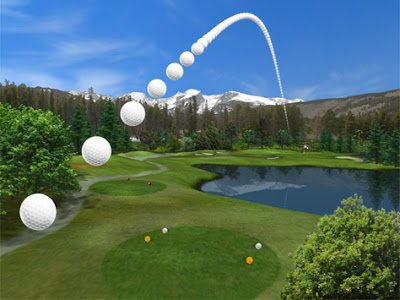
When it comes to improving your golf game, you can spend thousands of dollars buying the latest titanium-induced, Tiger-promoted golf clubs; taking private lessons from the local "I used to be on the Tour" pro; or trying every slice-correcting, swing-speed-estimating, GPS-distance-guessing gadget. But, in the end, it’s about getting that little white sphere to go where you intended it to go. Don't worry, there are many very smart people trying to help you by designing the ultimate golf ball. Of course, they are also after a slice of this billion dollar industry, as any technological advancement that can grab a few more market share points is worth the investment.

In fact, the golf ball wars can get nasty. Earlier this month, Callaway Golf won a court order permanently halting sales of the industry's leading ball, Titleist's Pro V1, arguing patent infringements involving its solid core technology which Callaway acquired when it bought Spaulding/Top Flite in 2003. Titleist disagrees with the decision and will appeal, but in the meantime has altered its manufacturing process so that the patents in question are not used.

The challenge for golf ball manufacturers is to design a better performing ball within the constraints set by United States Golf Association. The USGA enforces limits on the size, weight and initial performance characteristics in an attempt to keep the playing field somewhat level. Every "sanctioned" golf ball must weigh less than 1.62 ounces with a diameter smaller than 1.68 inches. It also must have a similar initial velocity when hit with a metal striker, and rebound at the same angle and speed when hit against a metal block. So, what is left to tinker with? Manufacturers have focused on the internal materials in the ball and its cover design.

Today's balls have 2, 3 or 4 layers of different internal polymer materials to be able to respond differently when hit with a driver versus, say, a wedge. When hit with a driver at much higher swing speed, the energy transfer goes all the way to the core by compressing ball, reducing backspin. During a slower swing with a club that has more angle loft, the energy stays closer to the surface of the ball and allows the grooves of the club to grab onto the ball's cover producing more spin. When driving the ball off of the tee, the preference is more distance and less loft, so a lower backspin is required. For closer shots, more backspin and control are needed.

The Science of Dimples
Which brings us to the cover of the ball and all of the design possibilities. Two forces affect the flight and distance of flying spheres, gravity and aerodynamics. Eventually, gravity wins once the momentum of the ball is slowed by the aerodynamic drag. Since all golf clubs have some angular loft to their clubface, the struck ball will have backspin. As explained by the Magnus Force effect, the air pressure will be lower on the top of the ball since that side is moving slower relative to the air around it. This creates lift as the ball will go in the direction of the lower air pressure. Counteracting this lift is the friction or drag the ball experiences while flying through the air.

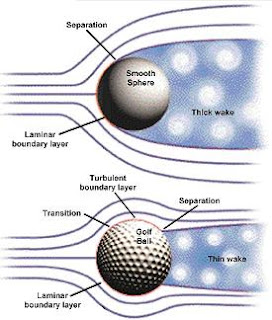
Think about a boat moving through water. At the front of the boat, the water moves smoothly around the sides of the boat, but eventually separates from the boat on the back side. This leaves behind a turbulent wake where the water is agitated and creates a lower pressure area. The larger the wake, the more drag is created. A ball in flight has the same properties.

The secret then is how to reduce this wake behind the ball. Enter the infamous golf ball dimples. Dimples on a golf ball create a thin turbulent boundary layer of air molecules that sticks to the ball's contour longer than on a smooth ball. This allows the flowing air to follow the ball's surface farther around the back of the ball, which decreases the size of the wake. In fact, research has shown that a dimpled ball travels about twice as far as a smooth ball.


So, the design competition comes down to perfecting the dimple, since not all dimples are created equal! The number, size and shape can have a dramatic impact on performance. Typically, today's balls have 300-500 spherically shaped dimples, each with a depth of about .010 inch. However, varying just the depth by .001 inch can have dramatic effects on the ball's flight.

Regarding shape, these traditional round dimple patterns cover up to 86 percent of the surface of the golf ball. To create better coverage, Callaway Golf's HX ball uses hexagon shaped dimples that can create a denser lattice of dimples leaving fewer flat spots. Creating just the right design has traditionally been a trial-and-error process of creating a prototype then testing in a wind tunnel. This time-consuming process does not allow for the extreme fine-tuning of the variables.

Simulation Solution
At the 61st Meeting of the American Physical Society's Division of Fluid Dynamics this week in San Antonio, a team of researchers from Arizona State University and the University of Maryland is reporting new findings that may soon give golf ball manufacturers a more efficient method of testing their designs. Their research takes a different approach, using mathematical equations that model the physics of a golf ball in flight. ASU's Clinton Smith, a Ph.D. student and his advisor Kyle Squires collaborated with Nikolaos Beratlis and Elias Balaras at the University of Maryland and Masaya Tsunoda of Sumitomo Rubber Industries, Ltd. The team has been developing highly efficient algorithms and software to solve these equations on parallel supercomputers, which can reduce the simulation time from years to hours.

Now that the model and process is in place, the next step is to begin the quest for the ultimate dimple. In the meantime, when someone asks you, "What's your handicap?" you can confidently tell them, "Well, my golf ball's design does not optimize its drag coefficient which results in a lower loft and spin rate from its poor aerodynamics."

Please visit my other articles on Livescience.com

Related Articles on Sports Are 80 Percent Mental:
Putt With Your Brain - Part 2 

Getting The Call Right With Technology


The loneliest men in sports have not been making any friends lately. 
Both umpires and referees have been making news, despite their often repeated goal, stated by World Series rookie umpire Tom Hallion said last month after Game 3: “As an umpire, you never want to be involved in the outcome of the game.” He added: “We like to get every play right. We’re human beings, and sometimes we get them wrong.” 
Hallion and his five partners at October's Fall Classic did not quite reach their goal. In Game 3, Hallion called Carl Crawford safe at first on a close play, but replays showed he was out. In Game 4, it was the Phillies who benefited after veteran umpire, Tim Welke, called Jimmy Rollins safe at third during a rundown, despite an obvious tag on his backside.


The men in stripes are not doing any better. Veteran NFL referee, Ed Hoculi (aka "Guns"), blew a call in Week 2's Broncos/Chargers game.  Broncos' quarterback Jay Cutler let the ball slip out of his hand and the Chargers recovered.  However, Hoculi ruled the play an incomplete pass. The video replay booth called it a fumble, but since Hoculi had blown his whistle, the call could not be reversed. 
Not to be outdone by their American counterparts, two English soccer officials have set a new standard for head-scratching calls.
In a Sept. 22 game between Watford and Reading, referee Stuart Atwell and one of his linesmen, Nigel Bannister, combined to become the ultimate sales pitch for any type of goal-line replay technology. After a scramble in front of goal, the ball bounced across the end line, two yards wide of the nearest goalpost. As both teams headed up the field and Watford prepared for a goal kick, Bannister signaled to Atwell that he saw the ball cross the line between the goalposts and that Reading should be awarded a goal. To the astonishment of all 22 players on the field and the 14,761 fans, Atwell overruled his own eyes and gave the goal to Reading. The replay made it painfully obvious how wrong the call was: 


So, assuming officials want some kind of automated technical assistance, what is available?
First, pure video instant replay gives officials a second, slower chance to see the play again and possibly adjust their live call. All four major sports leagues in the United States use replay at some level. 
In addition to judging if a shot was taken before the buzzer, the NBA added replay this season to differentiate 2-point versus 3-point baskets. MLB commissioner Bud Selig has put a stop to the spread of replay beyond the home run/foul ball call for now, but public pressure may change that. The NHL’s use of replay focuses mainly on different goal scoring scenarios. The NFL is the most advanced user of replay to judge multiple situations.
Second, an emerging selection of decision-support tools can make the actual call for the officials using location-based technology. In tennis, the Hawk-Eye system is being used at such high-profile events as Wimbledon and the U.S. Open. 
A system of six high-speed cameras records a ball's movement, which is useful when it bounces near one of the court lines. It feeds the cameras' input to a central computer that analyzes the data from all angles and then creates a motion graphic that simulates the ball's location when it bounces on the court, either on the line or next to the line, with a judgment of "in" or "out."
A player can challenge a line umpire's original call, but Hawk-Eye's ruling is then final. The interesting illusion that tennis fans have accepted is watching this 3D simulation as if it is based on a single camera’s footage of the ball. Actually, the sequence shown to viewers is Hawk-Eye's best estimate as to what actually happened based on the data it received from the cameras. There have been more than 550 challenges at the U.S. Open since 2006 when Hawk-Eye was installed. Thirty percent of those challenges resulted in a call being reversed.
In soccer, Adidas and Cairos Technologies have partnered to create an "intelligent" ball that includes a microchip that transmits its location on the field to a computer. 
The system also places a thin, underground electrical wire that surrounds each goal. If the ball's location is sensed to be completely inside the boundary of the goal, a signal is sent to a watch worn by the referee indicating that a goal has been scored. 
This technology would have saved Atwell and Bannister from their embarrassment. However, after extensive testing at several FIFA tournaments, Sepp Blatter, president of FIFA, announced in March that instead of technology, two additional human referee assistants would be used to judge whether a goal was scored. "Let it be as it is and let's leave it (soccer) with errors," Blatter said. "The television companies will have the right to say he (the referee) was right or wrong, but still the referee makes the decision — a man, not a machine." Interestingly, the English Premier League was also testing the use of Hawk-Eye as an alternative to Adidas' smart ball.
Even if the umps and refs don't want to use the technology, sports television producers still want to empower the fans.
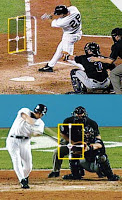
In baseball, ESPN's "K-zone" and Fox Sports' "Fox Trax" show a virtual representation of pitches and the strike zone to let us judge the accuracy of the home-plate umpire's calls. Think that last called strike was a bit outside?  Watch the computer generated replay that is accurate to within one-half inch. 
Then, go ahead and yell at the ump. If only they could come up with a way to transmit our voices directly into the stadium.

Please visit my other articles on Livescience.com

Hockey Hits Are Hurting More


One painful lesson every National Hockey League rookie learns is to keep your head up when skating through the neutral zone. If you don't, you will not see the 4700 joules of kinetic energy skating at you with bad intentions.
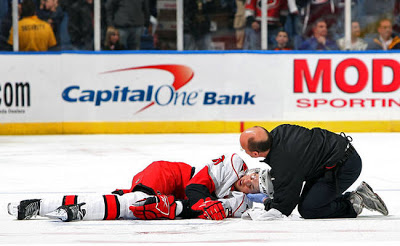
During an October 25th game, Brandon Sutter, rookie center for the Carolina Hurricanes, never saw Doug Weight, veteran center of the New York Islanders, sizing him up for a hit that resulted in a concussion and an overnight stay in the hospital.  Hockey purists will say that it was a "clean hit" and Weight was not penalized.

Six days before that incident, the Phoenix Coyotes' Kurt Sauer smashed Andrei Kostitsyn of the Montreal Canadiens into the sideboards. Kostitsyn had to be stretchered off of the ice and missed two weeks of games with his concussion. Sauer skated away unhurt and unpenalized. See video here.

Big hits have always been part of hockey, but the price paid in injuries is on the rise. According to data released last month at the National Academy of Neuropsychology's Sports Concussion Symposium in New York, 759 NHL players have been diagnosed with a concussion since 1997. For the ten seasons studied, that works out to about 76 players per season and 31 concussions per 1,000 hockey games. During the 2006-07 season, that resulted in 760 games missed by those injured players, an increase of 41% from 2005-06. Researchers have found two reasons for the jump in severity, the physics of motion and the ever-expanding hockey player.
In his book, The Physics of Hockey, Alain Haché, professor of physics at Canada's University of Moncton, aligns the concepts of energy, momentum and the force of impact to explain the power of mid-ice and board collisions.
As a player skates from a stop to full speed, his mass accelerates at an increasing velocity. The work his muscles contribute is transferred into kinetic energy which can and will be transferred or dissipated when the player stops, either through heat from the friction of his skates on the ice, or through a transfer of energy to whatever he collides with, either the boards or another player.
The formula for kinetic energy, K = (1/2)mass x velocity2, represents the greater impact that a skater's speed (velocity) has on the energy produced. It is this speed that makes hockey a more dangerous sport than other contact sports, like football, where average player sizes are larger but they are moving at slower speeds (an average of 23 mph for hockey players in full stride compared to about 16 mph for an average running back in the open field).
So, when two players collide, where does all of that kinetic energy go? First, let's look at two billiard balls, with the exact same mass, shape and rigid structure. When two balls collide on the table, we can ignore the mass variable and just look at velocity. If the ball in motion hits another ball that is stationary, then the ball at rest will receive more kinetic energy from the moving ball so that the total energy is conserved. This will send the stationary ball rolling across the table while the first ball almost comes to a stop as it has transferred almost all of its stored energy.
Unfortunately, when human bodies collide, they don't just bounce off of each other. This "inelastic" collision results in the transfer of kinetic energy being absorbed by bones, tissues and organs. The player with the least stored energy will suffer the most damage from the hit, especially if that player has less "body cushion" to absorb the impact.
To calculate your own real world energy loss scenario, visit the Exploratorium's "Science of Hockey" calculator. For both Sutter and Kostitsyn, they received checks from players who outweighed them by 20 pounds and were skating faster.
The average mass and acceleration variables are also growing as today's NHL players are getting bigger and faster. In a study released in September, Art Quinney and colleagues at the University of Alberta tracked the physiological changes of a single NHL team over 26 years, representing 703 players. Not surprisingly, they found that defensemen are now taller and heavier with higher aerobic capacity while forwards were younger and faster. Goaltenders were actually smaller with less body mass but had better flexibility. However, the increase in physical size and fitness did not correspond with team success on the ice. But the checks sure hurt a lot more now. 
Please visit my other articles on Livescience.com

Wait Until After The Season To Fire The Coach


Your high school guidance counselor should have steered you away from these three career paths: hand grenade tester, freezer salesman in Siberia and head coach of just about any sport. The longevity and success potential of each is limited.

Just halfway through the current 16-game NFL season, three coaches, Lane Kiffin (Oakland Raiders), Scott Linehan (St. Louis Rams) and Mike Nolan (San Francisco 49ers), have been asked to "pursue other opportunities."

Add to that two NHL coaches, Denis Savard (Chicago Blackhawks), who only made it to the fourth game of this year's 82-game schedule and now Barry Melrose, who was just fired after only 16 games. On the other end of the season, Ned Yost (Milwaukee Brewers), led his baseball team through 150 regular season games only to be fired with 12 games left in the season, even though the Brewers were still battling for a playoff spot.

Of course, we all should be so lucky to be bought out of our multi-million dollar contracts, so that we could contemplate our vocational options from a Caribbean beach. But do all of these pink slips and "interim" coaches help a team?

Since 1970, no NFL head coach hired in midseason has even made it to the playoffs, never mind the Super Bowl. And, while the Brewers did make the postseason this year, their record was only 7-5 in those last 12 games and then they lost in the divisional series, four games to one.

Yet team owners continue to panic and react rather than stick with the coach that, at one time, they felt was the man for the job. On the off chance that these owners enjoy reading academic research papers, two recent studies could confirm for them that reaching for the hook during midseason is not supported by results.

Economics professors from the Universita della Calabria, Maria De Paola and Vincenzo Scoppa, looked at the top Italian soccer league, Serie A, over five seasons from 2003-04 to 2007-08. Serie A is one of the most well-known leagues in the world, and an average of 41 percent of its 20 teams changed coaches during any given year in this five-year dataset. The researchers measured team performance before and after each of the 40 changes, using team points (3 for a win, 1 for a tie, and 0 for a loss), goals scored, goals against and their difference, known as goal differential.  The results showed no statistically significant improvements in team performance.

For several reasons that De Paola and Scoppa point out, this makes logical sense. So much of a team's success is determined when they first step on the field at the beginning of the season. The quality of the players on the roster, the tactical system that is in place and the influence of the fans and local media are variables that a new coach may not able to affect.

The game schedule can also play a role. If a team faces a string of tough opponents early in the season, the old coach may be unfairly compared to the new coach who has an easier schedule after the change. Also, over the course of a season, each team's record will statistically gather around its expected performance level. Since most coaching changes are made after a run of poor results, the new coach may benefit from a simple "regression to the mean" by enjoying a string of good results that may have nothing to do with the coach.

Change the sport and the league and the results are still the same. Three researchers led by Leif Arnesson at Mid Sweden University collected data from 30 years of the Elitserien or Swedish Elite League, the NHL of Sweden, to measure the impact of changing head coaches midseason.

"The results of our study indicate rather clearly that it was a mistake to replace the coach in all of these cases," says Arnesson. "If you're thinking about getting a new coach, you should at least avoid making your move while the season is under way. A word of advice to those who are in charge of recruiting coaches is therefore: 'Don't replace the coach, at any rate if you have a good coach, if you're in the middle of the season, or if the team is in trouble."

While the old saying, "you can't fire all the players so you might as well fire the coach", seems like the quick fix to a underperforming season, owners and fans should probably be patient.  At the end of the season, however, its a "whole new ball game" so we can "get 'em next year"!

Please visit my other articles on Livescience.com
Rotate It Like Ronaldo?


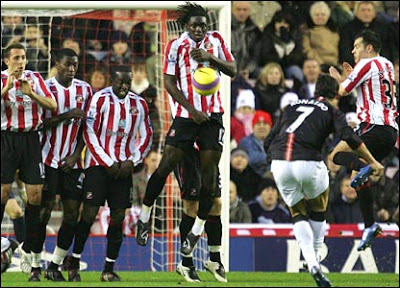
"Rotate it like Ronaldo" just doesn't have the same ring to it as "Bend it like Beckham", but the curving free kick is still one of the most exciting plays in soccer/football. Starting with Rivelino in the 1970 World Cup and on to the specialists of today, more players know how to do it and understand the basic physics behind it, but very few can perfect it. But, when it does happen, by chance or skill, it is the highlight of the game.


But let's take a look at this from the other side, through the eyes of the goalkeeper. Obviously, its their job to anticipate where the free kick is going and get to the spot before the ball crosses the line. He sets up his wall to, hopefully, narrow the width of the target, but he knows some players are capable of bending the ball around or over the wall towards the near post. If you watch highlights of free kick goals, you often see keepers flat-footed, just watching the ball go into the top corner. Did they guess wrong and then were not able to react? Did they guess right but misjudged the flight trajectory of the ball. How much did the sidespin or "bend" affect their perception of the exact spot where the ball will cross the line? To get an idea of the effect of spin, here's a compilation of Beckham's best free kick goals (there's a 15 second intro, then the highlights) :


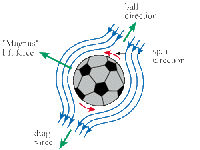
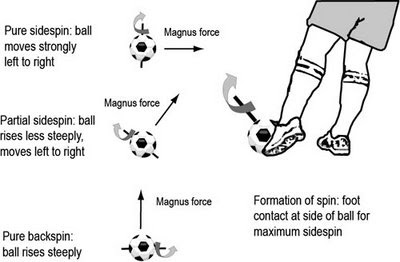
Researchers at Queen's University Belfast and the University of the Mediterranean in France tried to figure this out in this paper. They wanted to compare the abilities of expert field players and expert goalkeepers to accurately predict if a free kick would result in an on-target goal or off-target non-goal. First, a bit about why the ball "bends". We can thank what's called the "Magnus Force" named after the 19th-century German physicist Gustav Magnus. As seen in the diagram below, as the ball spins counter clockwise (for a right-footed player using his instep and kicking the ball on the right side), the air pressure on the left side of the ball is lower as the spin is in the same direction as the oncoming air flow. On the right side of the ball, the spin is in the opposite direction of the air flow, building higher pressure. The ball will follow the path of least resistance, or pressure, and "bend" or curve from right to left. The speed of the spin and the velocity of the shot will determine the amount of bend. For a clockwise spin, the ball bends from left to right.


The researchers showed the players three different types of simulated kicks, a kick bent to the right, a kick bent to the left and a kick with no spin at all. They showed the players these simulations with virtual reality headsets and computer controlled "kicks" and "balls" which they could vary in flight with different programming. The balls would disappear from view at distances of 10 and 12.5 meters from the goal. The reasoning is that this cutoff would correspond with the deadline for reaction time to make a save on the ball. In other words, if the keeper does not correctly guess the final trajectory and position of the ball by this point, he most likely will not be able to physically get to the ball and make the save.


The results showed that both the players and the keepers, (all 20 were expert players from elite clubs like AC Milan, Marseille, Bayer Leverkusen, Schalke 04), were able to correctly predict the result of the kicks with no spin added. However, as 600 RPM spin, either clockwise or counter-clockwise, was added to the ball, the players success declined significantly. Interestingly, the keepers did no better, statistically, then the field players. The researchers conclusion was that the players used the "current heading direction" of the ball to predict the final result, rather than factoring the future affect of the acceleration and change in trajectory caused by the spin.


Just as we saw in the Baseball Hitting post, our human perception skill in tracking flying objects, especially those that are spinning and changing direction, are not perfect. If we understand the physics of the spinning ball, we can better guess at its path, but the pitcher or the free kick taker doesn't usually offer this information beforehand!


Craig, C.M., Berton, E., Rao, G., Fernandez, L., Bootsma, R.J. (2006). Judging where a ball will go: the case of curved free kicks in football. Naturwissenschaften, 93(2), 97-101. DOI: 10.1007/s00114-005-0071-0

Baseball Brains - Fielding Into The World Series

With the crack of the bat, the ball sails deep into the outfield. The center-fielder starts his run back and to the right, trying to keep his eyes on the ball through its flight path. His pace quickens initially, then slows down as the ball approaches. He arrives just in time to make the catch. What just happened? How did he know where to run and at what speed so that he and the ball intersected at the same exact spot on the field. Why didn't he sprint to the landing spot and then wait for the ball to drop, instead of his controlled speed to arrive just when the ball did? What visual cues did he use to track the ball's flight?  Did Willie Mays make the most famous catch in baseball history because he is one of the greatest players of all-time with years of practice? Maybe, but now take a look at this "Web Gems" highlight video of 12 and 13 year-olds from last year's Little League World Series:

Just like we learned in pitching and hitting, fielding requires extensive mental abilities involving eyes, brain, and body movements to accomplish the task. Some physical skills, such as speed, do play a part in catching, but its the calculations and estimating that our brain has to compute that we often take for granted. The fact that fielders are not perfect in this skill, (there are dropped fly balls, or bad judgments of ball flight), begs the question of how to improve? As we saw with pitching and hitting (and most sports skills), practice does improve performance. But, if we understand what our brains are trying to accomplish, we can hopefully design more productive training routines to use in practice.

Once more, we turn to Mike Stadler, associate professor of psychology at University of Missouri, who provides a great overview of current fielding research in his book, "The Psychology of Baseball".

One organization that does not take this skill for granted is NASA. The interception of a ballistic object in mid-flight can describe a left fielder's job or an anti-missile defense system or how a pilot maneuvers a spacecraft through a three dimensional space. In fact, Michael McBeath , a former post doctoral fellow at the NASA Ames Research Center, (now an associate professor at Arizona State University), has been studying fly ball catching since 1995, beginning with his research study, "How baseball outfielders determine where to run to catch fly ball". 

His team developed a rocket-science like theory named Linear Optical Trajectory to describe the process that a fielder uses to follow the path of a batted ball. LOT says the fielder will adjust his movement towards the ball so that its trajectory follows a straight line through his field of vision. Rather than compute the landing point of the ball, racing to that spot and waiting, the fielder uses the information provided by the path of the ball to constantly adjust his path so that they intersect at the right time and place.

The LOT theory is an evolution from an earlier theory called Optical Acceleration Cancellation (OAC) that had the same idea but only explained the fielder's tracking behavior in the vertical dimension. In other words, as the ball leaves the bat the fielder watches the ball rise in his field of vision. If he were to stand still and the ball was hit hard enough to land behind him, his eyes would track the ball up and over his head, or at a 90 degree angle. If the ball landed in front of him, he would see the ball rise and fall but his viewing angle may not rise above 45 degrees. LOT and OAC argue that the fielder repositions himself throughout the flight of the ball to keep this viewing angle between 0 and 90 degrees. If its rising too fast, he needs to turn and run backwards. If the viewing angle is low, then the fielder needs to move forward so that the ball doesn't land in front of him. He can't always make to the landing spot in time, but keeping the ball at about a 45 degree angle by moving will help ensure that he gets there in time. While OAC explained balls hit directly at a fielder, LOT helps add the side-to-side dimension, as in our example of above of a ball hit to the right of the fielder.  More recently, McBeath has successfully defended his LOT theory here and here.

The OAC and LOT theories do agree on a fundamental cognitive science debate. There are two theories of how we perceive the world and then react to it. First, the Information Processing (IP) theory likens our brain to a computer in that we have inputs, our senses that gather information about the world, a memory system that stores all of our past experiences and lessons learned, and a "CPU" or main processor that combines our input with our memory and computes the best answer for the given problem. So, IP would say that the fielder sees the fly ball and offers it to the brain as input, the brain then pulls from memory all of the hundreds or thousands of fly ball flight paths that have been experienced, and then computes the best path to the ball's landing point based on what it has "learned" through practice. McBeath's research and observations of fielders has shown that the processing time to accomplish this task would be too great for the player to react.

OAC and LOT subscribe to the alternate theory of human perception, Ecological Psychology (EP). EP eliminates the call to memory from the processing and argues that the fielder observes the flight path of the ball and can react using the angle monitoring system. This is still up for debate as the IPers would argue "learned facts" like what pitch was thrown, how a certain batter hits those pitches, how the prevailing wind will affect the ball, etc. And, with EP, how can the skill differences between a young ballplayer and an experienced major leaguer be accounted for? What is the point of practice, if the trials and errors are not stored/accessed in memory?

Of course, we haven't mentioned ground balls and their behavior, due to the lack of research out there. The reaction time for a third baseman to snare a hot one-hopper down the line is much shorter. This would also argue in favor of EP, but what other systems are involved?

Arguing about which theory explains a fielder's actions is only productive if we can apply the research to create better drills and practices for our players. The LOT theory seems to be  getting there as an explanation, but there is still debate over EP vs. IP . So many sport skills rely on some of these foundations, that this type of research will continue to be relevant.  As with pitching and hitting, fielding seems to improve with practice.

And then there's the ultimate catch of all-time, that baseball fans have long been buzzing about.  Your reward for getting to the end of this article is this little piece of history...


You were looking for Willie Mays and "The Catch", weren't you?  This ball girl would own the best all-time fielding achievement... if it were real.  But no, just another digital editing marvel.  This was going to be a commercial for Gatorade, then it was put on the shelf.  After it was leaked onto YouTube, the video hoax became a viral hit.  So much so, that Gatorade left it on YouTube and did make a commercial out of it for the 2008 All-Star game.  But, you don't need to tell your Little Leaguers.  Let them dream...

Baseball Brains - Hitting Into The World Series

Ted Williams, arguably the greatest baseball hitter of all-time, once said, "I think without question the hardest single thing to do in sport is to hit a baseball". Williams was the last major league player to hit .400 for an entire season and that was back in 1941, 67 years ago! In the 2008 Major League Baseball season that just ended, the league batting average for all players was .264, while the strikeout percentage was just under 20%. So, in ten average at-bats, a professional ballplayer, paid millions of dollars per year, gets a hit less than 3 times but fails to even put the ball in play 2 times. So, why is hitting a baseball so difficult? What visual, cognitive and motor skills do we need to make contact with an object moving at 70-100 mph?

In the second of three posts in the Baseball Brains series, we'll take a quick look at some of the theory behind this complicated skill. Once again, we turn to Professor Mike Stadler and his book "The Psychology of Baseball" for the answers.  First, here's the "Splendid Splinter" in action:

A key concept of pitching and hitting in baseball was summed up long ago by Hall of Fame pitcher Warren Spahn, when he said, “Hitting is timing. Pitching is upsetting timing.” To sync up the swing of the bat with the exact time and location of the ball's arrival is the challenge that each hitter faces. If the intersection is off by even tenths of a second, the ball will be missed. Just as pitchers need to manage their targeting, the hitter must master the same two dimensions, horizontal and vertical. The aim of the pitch will affect the horizontal dimension while the speed of the pitch will affect the vertical dimension. The hitter's job is to time the arrival of the pitch based on the estimated speed of the ball while determining where, horizontally, it will cross the plate. The shape of the bat helps the batter in the horizontal space as its length compensates for more error, right to left. However, the narrow 3-4" barrel does not cover alot of vertical ground, forcing the hitter to be more accurate judging the vertical height of a pitch than the horizontal location. So, if a pitcher can vary the speed of his pitches, the hitter will have a harder time judging the vertical distance that the ball will drop as it arrives, and swing either over the top or under the ball.

A common coach's tip to hitters is to "keep your eye on the ball" or "watch the ball hit the bat". As Stadler points out, doing both of these things is nearly impossible due to the concept known as "angular velocity". Imagine you are standing on the side of freeway with cars coming towards you. Off in the distance, you are able to watch the cars approaching your position with re
lative ease, as they seem to be moving at a slower speed. As the cars come closer and pass about a 45 degree angle and then zoom past your position, they seem to "speed up" and you have to turn your eyes/head quickly to watch them. While the car is going at a constant speed, its angular velocity increases making it difficult to track.

This same concept applies to the hitter. As the graphic above shows (click to enlarge), the first few feet that a baseball travels when it leaves a pitcher's hand is the most important to the hitter, as the ball can be tracked by the hitter's eyes. As the ball approaches past a 45 degree angle, it is more difficult to "keep your eye on the ball" as your eyes need to shift through many more degrees of movement. Research reported by Stadler shows that hitters cannot watch the entire flight of the ball, so they employ two tactics.

First, they might follow the path of the ball for 70-80% of its flight, but then their eyes can't keep up and they estimate or extrapolate the remaining path and make a guess as to where they need to swing to have the bat meet the ball. In this case, they don't actually "see" the bat hit the ball. Second, they might follow the initial flight of the ball, estimate its path, then shift their eyes to the anticipated point where the ball crosses the plate to, hopefully, see their bat hit the ball. This inability to see the entire flight of the ball to contact point is what gives the pitcher the opportunity to fool the batter with the speed of the pitch. If a hitter is thinking "fast ball", their brain will be biased towards completing the estimated path across the plate at a higher elevation and they will aim their swing there. If the pitcher actually throws a curve or change-up, the speed will be slower and the path of the ball will result in a lower elevation when it crosses the plate, thus fooling the hitter.

To demonstrate the effect of reaction time for the batter, FSN Sport Science compared hitting a 95 mph baseball at 60' 6" versus a 70 mph softball pitched from 43' away.  The reaction time for the hitter went from .395 seconds to .350 seconds, making it actually harder to hit.  That's not all that makes it difficult.  Take a look:


As in pitching, the eyes and brain determine much of the success for hitters. The same concepts apply to hitting any moving object in sports; tennis, hockey, soccer, etc. Over time, repeated practice may be the only way to achieve the type of reaction speed that is necessary, but even for athletes who have spent their whole lives swinging a bat, there seems to be human limitation to success. Tracking a moving object through space also applies to catching a ball, which we'll look at next time.

Baseball Brains - Pitching Into The World Series


With the MLB League Championship Series' beginning this week, Twenty-six teams are wondering what it takes to reach the "final four" of baseball which leads to the World Series. The Red Sox, Rays, Phillies and Dodgers understand its not just money and luck. Over 162 games, it usually comes down to the fundamentals of baseball: pitching, hitting and catching. That sounds simple enough. So, why can't everyone execute those skills consistently? Why do pitchers struggle with their control? Why do batters strike out? Why do fielders commit errors? It turns out Yogi Berra was right when he said, "Baseball is 90% mental, and the other half is physical." In this three part series, each skill will be broken down into its cognitive sub-tasks and you may be surprised at the complexity that such a simple game requires of our brains.

First up, pitching or even throwing a baseball seems effortless until the pressure is on and the aim goes awry. Pitching a 3" diameter baseball 60 feet, 6 inches over a target that is 8 inches wide requires an accuracy of 1/2 to 1 degree. Throwing it fast, with the pressure of a game situation makes this task one of the hardest in sports. In addition, a fielder throwing to another fielder from 40, 60 or 150 feet away, sometimes off balance or on the run, tests the brain-body connection for accuracy. So, how do we do it? And how can we learn to do it more consistently? In his book, The Psychology of Baseball , Mike Stadler, professor of psychology at the University of Missouri, addresses each of these questions.

There are two dimensions to think about when throwing an object at a target: vertical and horizontal. The vertical dimension is a function of the distance of the throw and the effect of gravity on the object. So the thrower's estimate of distance between himself and the target will determine the accuracy of the throw vertically. Basically, if the distance is underestimated, the required strength of the throw will be underestimated and will lose the battle with gravity, resulting in a throw that will be either too low or will bounce before reaching the target. An example of this is a fast ball which is thrown with more velocity, so will reach its target before gravity has a path-changing effect on it. On the other hand, a curve ball or change-up may seem to curve downward, partly because of the spin put on the ball affecting its aerodynamics, but also because these pitches are thrown with less force, allowing gravity to pull the ball down. In the horizontal dimension, the "right-left" accuracy is related to more to the "aim" of the throw and the ability of the thrower to adjust hand-eye coordination along with finger, arm, shoulder angles and the release of the ball to send the ball in the intended direction.

So, how do we improve accuracy in both dimensions? Prof. Stadler points out that research shows that skill in the vertical/distance estimating dimension is more genetically determined, while skill horizontally can be better improved with practice. Remember those spatial organization tests that we took that show a set of connected blocks in a certain shape and then show you four more sets of conected blocks? The question is which of the four sets could result from rotating the first set of blocks. Research has shown that athletes that are good at these spatial relations tests are also accurate throwers in the vertical dimension. Why? The thought is that those athletes are better able to judge the movement of objects through space and can better estimate distance in 3D space. Pitchers are able to improve this to an extent as the distance to the target is fixed. A fielder, however, starts his throw from many different positions on the field and has more targets (bases and cut-off men) to choose from, making his learning curve a bit longer.

If a throw or pitch is off-target, then what went wrong? Research has shown that
despite all of the combinations of fingers, hand, arm, shoulder and body movements, it seems to all boil down to the timing of the finger release of the ball. In other words, when the pitcher's hand comes forward and the fingers start opening to allow the ball to leave. The timing of this release can vary by hundredths of a second but has significant impact on the accuracy of the throw. But, its also been shown that the throwing action happens so fast, that the brain could not consciously adjust or control that release in real-time. This points to the throwing action being controlled by what psychologists call an automated "motor program" that is created through many repeated practice throws. But, if a "release point" is incorrect, how does a pitcher correct that if they can't do so in real-time? It seems they need to change the embedded program by more practice.

Another component of "off-target" pitching or throwing is the psychological side of a player's mental state/attitude. Stadler identifies research that these motor programs can be called up by the brain by current thoughts. There seems to be "good" programs and "bad" programs, meaning the brain has learned how to throw a strike and learned many programs that will not throw a strike. By "seeding" the recall with positive or negative thoughts, the "strike" program may be run, but so to can the "ball" program. So, if a pitcher thinks to himself, "don't walk this guy", he may be subconsciously calling up the "ball" program and it will result in a pitch called as a ball. So, this is why sports pscyhologists stress the need to "think positively", not just for warm and fuzzy feelings, but the brain may be listening and will instruct your body what to do.


So, assuming Josh Beckett of the Red Sox is getting the ball across the plate, will the Rays hit it? That is the topic for next time when we look at hitting an object that is moving at 97 MPH and reaches you in less than half a second.

The Big Mo' - Momentum In Sports

A player can feel it during a game when they hit a game-changing home run or when they go 0 for 4 at the plate. A team can feel it when they come back from a deficit late in the game or when their lead in the division vanishes. A fan can feel it as their team "catches fire" or goes "as cold as ice". And, play-by-play announcers love to talk about it. 

We know it as the "Big Mo", the "Hot Hand", and being "In The Zone" while the psychologists call it Psychological Momentum. But, does it really exist? Is it just a temporary shift in confidence and mood or does it actually change the outcome of a game or a season? As expected, there are lots of opinions available.

The Oxford Dictionary of Sports Science defines psychological momentum as, "the positive or negative change in cognition, affect, physiology, and behavior caused by an event or series of events that affects either the perceptions of the competitors or, perhaps, the quality of performance and the outcome of the competition. Positive momentum is associated with periods of competition, such as a winning streak, in which everything seems to ‘go right’ for the competitors. In contrast, negative momentum is associated with periods, such as a losing streak, when everything seems to ‘go wrong’." 


The interesting phrase in this definition is that Psychological Momentum (PM) "affects either the perceptions of the competitors or, perhaps, the quality of performance and the outcome of the competition." Most of the analyses on PM focus on the quantitative side to try to prove or disprove PM's affect on individual stats or team wins and losses.

Regarding PM in baseball, a Wall St. Journal article looked at last year's MLB playoffs, only to conclude there was no affect on postseason play coming from team momentum at the end of the regular season. More recently, Another Cubs Blog also looked at momentum into this year's playoffs including opinion from baseball stats guru, Bill James, another PM buster. For basketball, Thomas Gilovich's 1985 research into streaky, "hot hand" NBA shooting is the foundation for most of today's arguments against the existence of PM, or at least its affect on outcomes.

This view that if we can't see it in the numbers, more than would be expected, then PM does not exist may not capture the whole picture. Lee Crust and Mark Nesti have recommended that researchers look at psychological momentum more from the qualitative side. Maybe there are more subjective measures of athlete or team confidence that contribute to success that don't show up in individual stats or account for teams wins and losses. 


As Jeff Greenwald put it in his article, Riding the Wave of Momentum, "The reason momentum is so powerful is because of the heightened sense of confidence it gives us -- the most important aspect of peak performance. There is a term in sport psychology known as self-efficacy, which is simply a player's belief in his/her ability to perform a specific task or shot. Typically, a player’s success depends on this efficacy. During a momentum shift, self-efficacy is very high and players have immediate proof their ability matches the challenge. As stated earlier, they then experience subsequent increases in energy and motivation, and gain a feeling of control. In addition, during a positive momentum shift, a player’s self-image also changes. He/she feels invincible and this takes the "performer self" to a higher level."

There would seem to be three distinct areas of focus for PM; an individual's performance within a game, a team's performance within a game and a team's performance across a series of games. So, what are the relationships between these three scenarios? Does one player's scoring streak or key play lift the team's PM, or does a close, hard-fought team win rally the players' morale and confidence for the next game? 


Seeing the need for a conceptual framework to cover all of these bases, Jim Taylor and Andrew Demick created their Multidimensional Model of Momentum in Sports, which is still the most widely cited model for PM. Their definition of PM, "a positive or negative change in cognition, affect, physiology, and behavior caused by an event or series of events that will result in a commensurate shift in performance and competitive outcome", leads to the six key elements to what they call the "momentum chain".

First, momentum shifts begin with a "precipitating event", like an interception or fumble recovery in football or a dramatic 3-point shot in basketball. The effect that this event has on each athlete varies depending on their own perception of the game situation, their self-confidence and level of self-efficacy to control the situation.

Second, this event leads to "changes in cognition, physiology, and affect." Again, depending on the athlete, his or her base confidence will determine how strongly they react to the events, to the point of having physiological changes like tightness and panic in negative situations or a feeling of renewed energy after positive events.

Third, a "change in behavior" would come from all of these internal perceptions. Coaches and fans would be able to see real changes in the style of play from the players as they react to the positive or negative momentum chain.

Fourth, the next logical step after behavior changes is to notice a "change in performance." Taylor and Demick note that momentum is the exception not the norm during a game. Without the precipitating event, there should not be noticeable momentum shifts.

Fifth, for sports with head to head competition, momentum is a two-way street and needs a "contiguous and opposing change for the opponent." So, if after a goal, the attacking team celebrates some increased PM, but the defending team does not experience an equal negative PM, then the immediate flow of the game should remain the same. Its only when the balance of momentum shifts from one team to the other. Levels of experience in athletes has been shown to mitigate the effects of momentum, as veteran players can handle the ups and downs of a game better than novices.

Finally, at the end of the chain, if momentum makes it that far, there should be an immediate outcome change. When the pressure of a precipitating event occurs against a team, the players may begin to get out of their normal, confident flow and start to overanalyze their own performance and skills. We saw this in Dr. Sian Beilock's research in our article, Putt With Your Brain - Part 2. As an athlete's skills improve they don't need to consciously focus on them during a game. But pressure brought on by a negative event can take them out of this "automatic" mode as they start to focus on their mechanics to fix or reverse the problem. 


As Patrick Cohn, a sport psychologist, pointed out in a recent USA Today article on momentum, "You stop playing the game you played to be in that position. And the moment you switch to trying not to screw up, you go from a very offensive mind-set to a very defensive mind-set. If you're focusing too much on the outcome, it's difficult to play freely. And now they're worried more about the consequences and what's going to happen than what they need to do right now."


There is no doubt that we will continue to hear references to momentum swings during games. When you do, you can conduct your own mini experiment and watch the reactions of the players and the teams over the next section of the game to see if that "precipitating event" actually leads to a game-changing moment.

ResearchBlogging.org


Jim Taylor, Andrew Demick (1994). A multidimensional model of momentum in sports Journal of Applied Sport Psychology, 6 (1), 51-70 DOI: 10.1080/10413209408406465

Retirement Rebound - The Return of Torres, Favre and Armstrong

Maybe its the fear of turning 40. Maybe its the feeling of unfinished business. Maybe its the fire in the belly that has not quite extinguished. For retired elite athletes, the itch is always there to make a return after experiencing "life after sport". For some, it becomes too strong to ignore. 

This year has seen the return of at least three champions, Dara Torres, Lance Armstrong and Brett Favre. As they explain their individual reasons for coming back, some similarities emerge that have more to do with psychological needs than practical needs. In a recent Miami Herald article, Torres explained her comeback to competitive swimming at age 41, "For me, it's not like I sat around and watched swimming on TV and thought, `Oh, I wish I was still competing'. It was more gradual. But all of a sudden, something goes off inside you and you start seriously thinking about a comeback. You'd think the competitive fire would die down with maturity, but I've actually gotten worse. I wasn't satisfied with silver medals. I hate to lose now more than I did in my 20s. I'm still trying to figure out why.''

Drawing inspiration from Torres, Lance Armstrong has decided to make a comeback at age 37 with a declared goal to win his eighth Tour de France. In a recent Vanity Fair article, he described his rationale, “Look at the Olympics. You have a swimmer like Dara Torres. Even in the 50-meter event [freestyle], the 41-year-old mother proved you can do it. The woman who won the marathon [Constantina Tomescu-Dita, of Romania] was 38. Older athletes are performing very well. Ask serious sports physiologists and they’ll tell you age is a wives’ tale. Athletes at 30, 35 mentally get tired. They’ve done their sport for 20, 25 years and they’re like, I’ve had enough. But there’s no evidence to support that when you’re 38 you’re any slower than when you were 32."

Is it the 40 factor? Brett Favre, who turns 39 in October, made his well-publicized return to the NFL last month wanting to return so badly that he accepted a trade to the New York Jets so that he could play. His public and emotional decision to retire in March, only to begin hinting at a comeback in early summer showed the internal struggle he had with stepping away from sports. 


You could hear the indecision in his retirement press conference, "I've given everything I possibly can give to this organization, to the game of football, and I don't think I've got anything left to give, and that's it.", Favre said. "I know I can play, but I don't think I want to. And that's really what it comes down to. Fishing for different answers and what ifs and will he come back and things like that, what matters is it's been a great career for me, and it's over. As hard as that is for me to say, it's over. There's only one way for me to play the game, and that's 100 percent. Mike and I had that conversation the other night, and I will wonder if I made the wrong decision. I'm sure on Sundays, I will say I could be doing that, I should be doing that. I'm not going to sit here like other players maybe have said in the past that I won't miss it, because I will. But I just don't think I can give anything else, aside from the three hours on Sundays, and in football you can't do that. It's a total commitment, and up to this point I have been totally committed." 

Some observers point to the end of the Packers' 2007-2008 season with a heart-wrenching Favre interception in overtime that sent the Giants to the Super Bowl instead of Green Bay. Being that close to the pinnacle of his sport must have been confidence that his skills had not diminished and once the fatigue of the past season had passed (by about June), that he was not ready to just ride the tractor in Mississippi for the next 40 years.

So, what do the sport psychologists make of these second thoughts? These three athletes are world famous, but what about the hundreds of professional athletes that have had to make the same decision without all of the front page stories and fanfare? Why does Chris Chelios, all-star and future Hall of Famer in the NHL, continue to avoid the retirement decision at age 45? 


Coaches aren't immune either. Bobby Bowden of Florida State and Joe Paterno of Penn State have refused to retire to the point of becoming an awkward story for their schools and fans. ''After all the adulation and excitement wear off and elite athletes come face to face with retirement and a more mundane life, they suffer a sense of loss, almost like a death,'' said sport psychologist John F. Murray. "If you're Lance Armstrong, you realize that what you are is a cyclist, that is your identity, and if you feel you have one or two more titles in you, why let it go? Why not tackle unresolved challenges? Competing at that level provides a high that is hard to match. How can you not be addicted to that?''

Beyond the professional ranks, thousands of college and Olympic athletes are left with the realization that they face similar decisions of when to "give up the dream" and move into the more practical world of finishing their education and finding a job. Their emotional attachment to their sport has developed over years of building an identity linked to their success on the field. 


Despite the statistics showing the "funnel effect" of the diminishing number of athletes getting to the "next level", younger athletes continue to believe they are the ones that will make it to the top. There is also the more emotional issue of unwillingly leaving a sport because of injury or simply not making the team due to diminished skills. Dr. Murray adds, "When your whole life has been geared toward athletic excellence, the prospects of retirement can be dreadful! This is commonplace at collegiate level where 99 per cent of the athletes do not go on to play their sport professionally. Counseling is a way to prepare athletes for the inevitable loss that occurs after the glory is over and only memories remain. As with any loss, people need effective ways to cope. Going at it all on your own might work for some, but I’ll submit that the vast majority of athletes benefit from early discussion and planning for retirement. There is definitely life after sport."

Some colleges and universities, as well as some professional teams, have started to offer formal "retirement planning" for athletes as their formal sport careers wind down. Life After Sports, a counseling firm started by Adrian McBride, a former college and NFL player, provides services to retiring college athletes to help them emotionally and practically adjust to a post-sports life. The University of North Carolina has set-up the Center for the Study of Retired Athletes to offer a home for academic research into these issues.

Additional academic research is also coming out on athlete retirement including two articles this year (see citations below) from the Journal of Applied Sport Psychology. First, Katie Warriner and David Lavallee of the University of Wales interviewed former elite gymnasts regarding their retirement at a relatively young age from competitive sport. They found the loss of identity to be the biggest adjustment. Second, Patricia Lally and Gretchen Kerr looked at how parents cope with their children's "retirement" from sport, as they also go through withdrawl symptoms when the "end of the dream" finally comes and the lifelong ambition for their child's athletic success is over.

Who's next up for a retirement rebound? Just as Lance got inspiration from Torres and maybe Favre, the trend may continue. The Bulls could use Jordan or Pippen and Roger Clemens is never far away from a phone. Stay tuned!

ResearchBlogging.org


Katie Warriner, David Lavallee (2008). The Retirement Experiences of Elite Female Gymnasts: Self Identity and the Physical Self Journal of Applied Sport Psychology, 20 (3), 301-317 DOI: 10.1080/10413200801998564

Patricia Lally, Gretchen Kerr (2008). The Effects of Athlete Retirement on Parents Journal of Applied Sport Psychology, 20 (1), 42-56 DOI: 10.1080/10413200701788172

Putt With Your Brain - Part 2

If there is a poster child sport for our favorite phrase, "Sports Are 80 Percent Mental", it must be golf. Maybe its the slow pace of play that gives us plenty of time to think between shots. Maybe its the "on stage" performance feeling we get when we step up to that first tee in front of our friends (or strangers!) Maybe its the "high" of an amazing approach shot that lands 3 feet from the cup followed by the "low" of missing the birdie putt. 

From any angle, a golf course is the sport psychologist's laboratory to study the mix of emotions, confidence, skill execution and internal cognitive processes that are needed to avoid buying rounds at the 19th hole. Last time, we looked at some of the recent research on putting mechanics, but, as promised, we now turn to the mental side of putting. Sian Beilock and her team at the University of Chicago's Human Performance Lab recently released the latest of a string of research studies on sports performance, or more specifically, how not to choke under pressure. Lucky for us, they chose putting as their sport skill of choice. This ties in with Dr. Beilock's theory of embodied cognition that we featured in Watching Sports Is Good For Your Brain.

An underlying theme to this work is the concept of automaticity, or the ability to carry out sport skills without consciously thinking about them. Performing below expectations (i.e. choking) starts when we allow our minds to step out of this automatic mode and start thinking about the steps to our putting stroke and all of those "swing thoughts" that come with it ("keep your elbows in", "head down", "straight back").


Our brain over analyzes and second-guesses the motor skills we have learned from hundreds of practice putts. Previously, we looked at automaticity in other sports. Of course, a key distinction to the definition of choking is that you are playing "well below expectations". If you normally shoot par, but now start missing easy putts, then there may be distractions that are taking you out of your normal flow. Choking implies a temporary and abnormal event. Automaticity theory would claim that it is these distractions from some perceived pressure to perform that are affecting your game.

Most research into sport skill performance divides the world into two groups, novices and experts. Most sports have their own measures of where the dividing line is between these groups. Expertise would imply performance results not just experience. So, a golfer who has been hacking away for 20 years but still can't break 100 would still be put in the "novice" category.


Sport scientists design experiments that compare performance between the groups given some variables, and then hypothesize on the reason for the observed differences. Beilock, et al have looked at golf putting from several different angles over the years. Their research builds on itself, so let's review in reverse chronological order.

Back in 2001, they began by comparing the two competing theories of choking, distraction theory vs. explicit monitoring theory, and designed a putting experiment to find the better explanation. Distraction theory explains choking by assuming that the task of putting requires your direct attention and that high pressure situations will cause you to perform dual tasks - focus on your putting but also think about the pressure. This theory assumes there is no automaticity in skill learning and that we have to focus our attention on the skill every time.


Explicit monitoring theory claims that over time, as we practice a skill to the point of becoming an "expert", we proceduralize the task so that it becomes "automatic". Then, during a high pressure situation, our brain becomes so concerned about performance that it takes us out of automatic mode and tries to focus on each step of the task. The research supported the explicit monitoring theory as it was shown that the golf putting task was affected by distractions and pressure for the experts but not the novice putters.

So, how do we block out the pressure, so that our automaticity can kick in? Another 2001 study by Beilock looked at mental imagery during putting. Using the same explicit monitoring theory, should we try to think positive thoughts, like "this ball is going in the hole" or "I have made this putt many times"? Also, what happens if a stray negative thought, "don't miss this one!" enters our brain? Should we try to suppress it and replace it with happy self-talk? She set up four groups, one receiving positive comments, one receiving negative comments, one receiving negative comments followed by positive comments and one receiving none as a control group.


As expected, the happy people did improve their putting over the course of the trials, while the negative imagery hurt performance. But, the negative replaced with positive thought group did not show any more improvement over the control group. So, when faced with a high pressure, stressful situation ripe with the possibilities of choking, try to repeat positive thoughts, but don't worry too much if the occasional doubt creeps in.

Our strategy towards putting should also vary depending on our current skill level. While learning the intricacies of putting, novices should use different methods than experts, according to a 2004 study by Beilock, et al. Novice golfers need to pay attention to the step by step components of their swing, and they perform better when they do focus on the declarative knowledge required. 


Expert golfers, however, have practiced their swing or putt so often that it has become "second nature" to the point that if they are told to focus on the individual components of their swing, they perform poorly. The experiment asked both novices and expert golfers to first focus on their actual putting stroke by saying the word "straight" when hitting the ball and to notice the alignment of the putter face with the ball. Next, they were asked to putt while also listening for a certain tone played in the background. When they heard the tone they were to call it out while putting. 

The first scenario, known as "skill-focused", caused the novices to putt more accurately but the experts to struggle. The second scenario, called "dual-task", distracted the novices enough to affect their putts, while the experts were not bothered and their putting accuracy was better. Beilock showed that novices need the task focus to succeed while they are learning to putt, while experts have internalized the putting stroke so that even when asked to do two things, the putting stroke can be put on "auto-pilot".

Finally, in 2008, Beilock's team added one more twist to this debate. Does a stress factor even affect a golfer's performance in their mind before they putt? This time, golfers, divided into the usual novice and expert groups, were asked to first imagine or "image execute" themselves making a putt followed by an actual putt. The stress factor was to perform one trial under a normal, "take all the time you need" time scenario and then another under a speeded or time-limited scenario. 


The novices performed better under the non-hurried scenario in imagining the putt first followed by the actual putt. The experts, however, actually did better in the hurried scenario and worse in the relaxed setting. Again, the automaticity factor explains the differences between the groups.

The bottom line throughout all of these studies is that if you're learning to play golf, which includes putting, you should focus on your swing/stroke but beware of the distractions which will take away your concentration. That seems pretty logical, but for those that normally putt very well, if you feel stress to sink that birdie putt, don't try to focus in on the mechanics of your stroke. Trust the years of experience that has taught your brain the combination of sensorimotor skills of putting.

Just remember the Chevy Chase/Ty Webb philosophy; "I'm going to give you a little advice. There's a force in the universe that makes things happen. And all you have to do is get in touch with it, stop thinking, let things happen, and be the ball.... Nah-na-na-na, Ma-na-na-na...."


ResearchBlogging.orgSian L. Beilock, Thomas H. Carr (2001). On the fragility of skilled performance: What governs choking under pressure? Journal of Experimental Psychology: General, 130 (4), 701-725 DOI: 10.1037//0096-3445.130.4.701

Sian L. Beilock; James A. Afremow; Amy L. Rabe; Thomas H. Carr (2001). "Don't Miss!" The Debilitating Effects of Suppressive Imagery on Golf Putting Performance Journal of Sport and Exercise Psychology, 23 (3)

Beilock S.L.; Bertenthal B.I.; McCoy A.M.; Carr T.H. (2004). Haste does not always make waste: Expertise, direction of attention, and speed versus accuracy in performing sensorimotor skills Psychonomic Bulletin & Review, 11 (2), 373-379

Sian Beilock, Sara Gonso (2008). Putting in the mind versus putting on the green: Expertise, performance time, and the linking of imagery and action The Quarterly Journal of Experimental Psychology, 61 (6), 920-932 DOI: 10.1080/17470210701625626

Putt With Your Brain - Part 1

If Mark Twain thinks golf is "a good walk spoiled", then putting must be a brief pause to make you reconsider ever walking again. With about 50% of our score being determined on the green, we are constantly in search of the "secret" to getting the little white ball to disappear into the cup. Lucky for us, there is no shortage of really smart people also looking for the answer. The first 8 months of 2008 have been no exception, with a golf cart full of research papers on just the topic of putting. 

Is the secret in the mechanics of the putt stroke or maybe the cognitive set-up to the putt or even the golfer's psyche when stepping up to the ball? This first post will focus on the mechanical side and then we'll follow-up next time with a look inside the golfer's mind.

Let's start with a tip that most golf instructors would give, "Keep your head still when you putt". Jack Nicklaus said it in 1974, "the premier technical cause of missed putts is head movement" (from "Golf My Way") and Tiger Woods said it in 2001, "Every good putter keeps the head absolutely still from start to finish" (from "How I Play Golf"). Who would argue with the two greatest golfers of all time? His name is Professor Timothy Lee, from McMaster University, and he wanted to test that observation. So, he gathered two groups of golfers, amateurs with handicaps of 12-40, and professionals with scratch handicaps. Using an infrared tracking system, his team tracked the motion of the putter head and the golfer's head during sixty putts.

As predicted, the amateurs' head moved back in unison with their putter head, something Lee calls an "allocentric" movement, which agrees with the advice that novice golfers move their head. However, the expert golfers did not keep their head still, but rather moved their heads slightly in the opposite direction of the putter head. On the backswing, the golfer's head moved slightly forward; on the forward stroke, the head moved slightly backward. This "egocentric" movement may be the more natural response to maintain a centered, balanced stance throughout the stroke.


"The exact reasons for the opposite coordination patterns are not entirely clear," explains Lee. "However, we suspect that the duffers tend to just sway their body with the motions of the putter. In contrast, the good golfers probably are trying to maintain a stable, central body position by counteracting the destabilization caused by the putter backswing with a forward motion of the head. The direction of head motion is then reversed when the putter moves forward to strike the ball." Does that mean that pro golfers like Tiger are not keeping their heads still? No, just that you may not have to keep your head perfectly still to putt effectively.

So, what if you do have the bad habit of moving your head? Just teach yourself to change your putting motion and you will be cutting strokes off of your score, right? Well, not so fast. Simon Jenkins of Leeds Metropolitan University tested 15 members of the PGA European Tour to see if they could break old physical habits during putting. His team found that players who usually use shoulder movement in their putting action were not able to change their ways even when instructed to use a different motion. Old habits die hard.

Let's say you do keep your head still (nice job!), but you still 3-putt most greens? What's the next step on the road to birdie putts? Of the three main components of a putt, (angle of the face of the putter head on contact, putting stroke path and the impact point on the putter), which has the greatest effect on success? Back in February, Jon Karlsen of the Norwegian School of Sport Sciences in Oslo, asked 71 elite golfers (mean handicap of 1.8) to make a total of 1301 putts (why not just 1300?) from about 12 feet to find out. His results showed that face angle was the most important (80%), followed by putter path (17%) and impact point (3%).

OK, forget the moving head thing and work on your putter blade angle at contact and you will be taking honors at every tee. Wait, Jon Karlsen came back in July with an update. This time he compared green reading, putting technique and green surface inconsistencies to see which of those variables we should discuss with our golf pro. Forty-three expert golfers putted 50 times from varying distances. Results showed that green reading (60%) was the most dominant factor for success with technique (34%) and green inconsistency (6%) trailing significantly.

So, after reading all of this, all you really need is something like the BreakMaster, which will help you read the breaks and the slope to the hole! Then, keep the putter blade square to the ball and don't move your head, at least not in an allocentric way, that is if you can break your bad habit of doing it. No problem, right? Well, next time we'll talk about your brain's attitude towards putting and all the ways your putt could go wrong before you even hit it!

ResearchBlogging.org

Timothy D. Lee, Tadao Ishikura, Stefan Kegel, Dave Gonzalez, Steven Passmore (2008). Head–Putter Coordination Patterns in Expert and Less Skilled Golfers Journal of Motor Behavior, 40 (4), 267-272 DOI: 10.3200/JMBR.40.4.267-272


Jenkins, Simon (2008). Can Elite Tournament Professional Golfers Prevent Habitual Actions in Their Putting Actions? International Journal of Sports Science & Coaching, 3 (1), 117-127


Jon Karlsen, Gerald Smith, Johnny Nilsson (2007). The stroke has only a minor influence on direction consistency in golf putting among elite players Journal of Sports Sciences, 26 (3), 243-250 DOI: 10.1080/02640410701530902

Four Sites You Have To Visit

When you start a new blog about a niche topic like "sports and brains", you definitely need some friends along the way to get your stories out there and noticed by readers. So, I just wanted to take a time-out to thank and recommend four terrific sites and the people behind them.


First, Guy Kawasaki has not only blogged and Tweeted my stories to thousands of his readers but has now added this site to one of the coolest news/blog aggregators on the Web, Alltop.com. If you haven't visited Alltop, it is best described as an "online newsstand" where you can pick your favorite category from a few hundred and then see hand-picked sites and their most recent stories. Of course, I have a certain bias towards sports.alltop.com and fitness.alltop.com (scroll to the bottom of each page to see why!).


And, for a mix of news, rumors and the best of the Web, stop by another Guy creation, Truemors. Besides being a serial entrepreneur and venture capitalist, Guy is best known as a popular author and speaker. Take a look at his work here: Books by Guy Kawasaki.
Second, Hank Campbell over at ScientificBlogging.com has made a home for my ramblings and provides a very active and large audience of smart science readers. ScientificBlogging partners with LiveScience.com, Space.com and the other Imaginova sites to offer a great end-to-end science news and blogging resource. ScientificBlogging and LiveScience headlines can also be found on science.alltop.com, while Space can be found on, get this, space.alltop.com.

Third, Dave Munger, of Cognitive Daily fame, (psychology.alltop.com), started a unique indexing service at ResearchBlogging.org. When citing an academic article, the Research Blogging site will provide HTML code to include in the post, so that it can be spidered and indexed and then categorized on the RB site. You can see the RB logo and citations on any post where I discuss some academic research. Dave has been a great help answering questions and supporting the site.

And, for a really cool mashup of all of these resources in action, here is a link at Truemors: Sports Viewing Boosts Brain Power, which links to my latest story at ScientificBlogging which links to my home blog here, which includes a citation that indexes it to my page at Research Blogging!!


Finally, thanks to all of you who stop by "80% Mental" to catch up on the latest sport science and sports cognition research. I absolutely enjoy researching, writing and presenting these stories and if you ever have questions or topics you would like covered, just leave me a comment! Don't forget that you can always subscribe to 80% Mental via your favorite news reader or by e-mail.

Watching Sports Is Good For Your Brain

When was the last time you listened to a sporting event on the radio? If given a choice between watching the game on a big screen plasma in HD or turning on the AM radio, most of us would probably choose the visual sensation of television. But, for a moment, think about the active attention you need in order to listen to a radio broadcast and interpret the play-by-play announcer's descriptions. As you hear the words, your "mind's eye" paints the picture of the action so you can imagine the scene and situations. Your knowledge of the game, either from playing it or watching it for years helps you understand the narrative, the terms and the game's "lingo".


Now, imagine that you are listening to a broadcast about a sport you know nothing about. Hearing Bob Uecker or Vin Scully say, "With two out in the ninth, the bases are loaded and the Brewers' RBI leader has two strikes. The infield is in as the pitcher delivers. Its a hard grounder to third that he takes on the short hop and fires a bullet to first for the final out." If you have no baseball-specific knowledge, those sentences are meaningless. 

However, for those of us that have grown up with baseball, that description makes perfect sense and our mind's eye helped us picture the scene. That last sentence about the "hard grounder" and the thrown "bullet" may have even triggered some unconscious physical movements by you as your brain interpreted those action phrases. That sensorimotor reaction is at the base of what is called "embodied cognition". 
 
Sian Beilock, associate professor of psychology and leader of the Human Performance Lab at the University of Chicago, defined the term this way: "In contrast to traditional views of the mind as an abstract information processor, recent work suggests that our representations of objects and events are grounded in action. That is, our knowledge is embodied, in the sense that it consists of sensorimotor information about potential interactions that objects or events may allow." She cites a more complete definition of the concept in Six Views of Embodied Cognition by Margaret Wilson. Another terrific overview of the concept is provided by science writer Drake Bennet of the Boston Globe in his article earlier this year, "Don't Just Stand There, Think".


In a study released yesterday, "Sports Experience Changes the Neural Processing of Action Language", Dr. Beilock's team continued their research into the link between our learned motor skills and our language comprehension about those motor skills. Since embodied cognition connects the body with our cognition, the sports domain provides a logical domain to study it.


Their initial look at this concept was in a 2006 study titled, "Expertise and its embodiment: Examining the impact of sensorimotor skill expertise on the representation of action-related text", where the team designed an experiment to compare the knowledge representation skill of experienced hockey players and novices. Each group first read sentences describing both hockey-related action and common, "every-day" action, (i.e. "the referee saw the hockey helmet on the bench" vs. "the child saw the balloon in the air"). They were then shown pictures of the object mentioned in the sentences and were asked if the picture matched the action in the sentence they read.

Both groups, the athletes and the novices, responded equally in terms of accuracy and response time to the everyday sentences and pictures, but the athletes responded significantly faster to the hockey-specific sentences and pictures. The conclusion is that those with the sensorimotor experience of sport give them an advantage of processing time over those that have not had that same experience.


Now, you may be saying, "Ya' think!?" to this somewhat obvious statement that people who have played hockey will respond faster to sentence/picture relationships about hockey than non-hockey players. Stay with us here for a minute, as the 2006 study set the groundwork for Beilock's team to take the next step with the question, "is there any evidence that the athletes are using different parts of their brain when processing these match or no match decisions?" The link between our physical skill memory and our language comprehension would be at the base of the embodied cognition theory. 

So, in the latest research, the HPL team kept the same basic experimental design, but now wanted to watch the participants' brain activity using fMRI scanning. This time, there were three groups, hockey players, avid fans of hockey and novices who had no playing or viewing experience with hockey at all. First, all groups passively listened to sentences about hockey actions and also sentences about everyday actions while being monitored by fMRI.  Second, outside of the fMRI scanner, they again listened to hockey-related and everyday-related action sentences and then were shown pictures of hockey or every day action and asked if there was a match or mis-match between the sentence and the picture.


This comprehension test showed similar results as in 2006, but now the team could try to match the relative skill in comprehension to the neural activity shown in the fMRI scans when listening. Both the players and the fans showed increased activity in the left dorsal premotor cortex, a region thought to support the selection of well-learned action plans and procedures. 

You might be surprised that the fans' brains showed activity in the same regions as the athletes. We saw this effect in a previous post, "Does Practice Make Perfect", where those that practiced a new dance routine and those that only watched it showed similar brain area activity. On the other side, the total novices showed activity in the bilateral primary sensory-motor cortex, an area typically known for carrying out step by step instructions for new or novel tasks. 

So, the interesting finding here is that those with experience, either playing or watching, are actually calling on additional neural networks in their brains to help their normal language comprehension abilities. In other words, the memories of learned actions are linked and assist other cognitive tasks. That sounds pretty much like the definition of embodied cognition and Dr. Beilock's research has helped that theory take another step forward. In her words, "Experience playing and watching sports has enduring effects on language understanding by changing the neural networks that support comprehension to incorporate areas active in performing sports skills."


Take pride in your own brain the next time you hear, "Kobe dribbles the ball to the top of the key, crosses over, drives the lane, and finger rolls over Duncan for two." If you can picture that play in your mind, your left dorsal premotor cortex just kicked into gear!


ResearchBlogging.org


S. L. Beilock, I. M. Lyons, A. Mattarella-Micke, H. C. Nusbaum, S. L. Small (2008). Sports experience changes the neural processing of action language Proceedings of the National Academy of Sciences DOI: 10.1073/pnas.0803424105


Lauren E. Holt, Sian L. Beilock (2006). Expertise and its embodiment: Examining the impact of sensorimotor skill expertise on the representation of action-related text Psychonomic Bulletin & Review, 13 (4), 694-701 PMID: 17201372

Video Games Move From The Family Room To The Locker Room

It sounds like a sales job from a 12 year old; "Actually, Dad, this is not just another video game. Its a virtual, scenario-based microcosm of real world experiences that will enhance my decision-making abilities and my cognitive perceptions of the challenges of the sport's environment."  You respond with, "So, how much is Madden 09?"  

With over 5 million copies of Madden 08 sold, the release of the latest version two weeks ago is rocketing up the charts.  Days and late nights are being spent all over the world creating rosters, customizing plays and playing entire seasons, all for pure entertainment purposes.  Can all of those hours spent with controller in hands actually be beneficial to young athletes?  Shouldn't they be outside in the fresh air and sunshine playing real sports?  Well, yes, to both questions.


Playing video games, (aka "gaming"), as a form of learning has been receiving increased recent attention from educational psychology researchers.  At this month's American Psychological Association annual convention, several groups of researchers presented studies of the added benefits of playing video games, from problem-solving and critical thinking to better scientific reasoning.  

In one of the studies by Fordham University psychologist Fran C. Blumberg, PhD, and Sabrina S. Ismailer, MSED, 122 fifth-, sixth- and seventh-graders' problem-solving behavior was observed while playing a video game that they had never seen before.  As the children played the game, they were asked to think aloud for 20 minutes. Researchers assessed their problem-solving ability by listening to the statements they were making while playing.   

The results showed that playing video games can improve cognitive and perceptual skills.  "Younger children seem more interested in setting short-term goals for their learning in the game compared to older children who are more interested in simply playing and the actions of playing," said Blumberg. "Thus, younger children may show a greater need for focusing on small aspects of a given problem than older children, even in a leisure-based situation such as playing video games."

Also, in a recent article on video game learning, David Williamson Shaffer, professor of educational psychology at the University of Wisconsin-Madision and author of the book "How Computer Games Help Children Learn", argues that if a game is realistically based on real-world scenarios and rules, it can help the child learn.  “The question though is," Shaffer said, "is what they are doing a good simulation of what is happening in the real world?"  Shaffer explains the research happening on this topic at his UW lab, named Epistemic Games:


Support for this new era of learning tools is coming from other interesting people, as well.  George Lucas of Star Wars fame has an educational foundation, Edutopia, which has shown recent interest in simulation learning.  Here is their introductory overview and accompanying video:


There are some words of caution out there.  In a recent article, educational psychologist Jane M. Healy, author of "Failure to Connect: How Computers Affect our Children's Minds and What We Can Do About It," urges educators to proceed carefully.  "The main question is whether the activity, whatever it is, is educationally valid and contributes significantly to whatever is being studied," she says.  "The point is not whether kids are 'playing' with learning, or what medium they are playing in — a ball field or a Wii setup or a physics lab or art studio — but rather why they are doing it.  Just because it is electronic does not make it any better, and it may turn out not to be as valuable."

If we accept that there is some validity to teaching/learning with video game simulations, how can we move this to the sports arena?  Obviously, there is no substitute for playing the real game with real players, opponents, pressure, etc., but more teams and coaches are turning to simulation games for greater efficiency in the learning process.  If the objective is to expose players to plays, tactics, field vision and critical thinking, then a gaming session can begin to introduce these concepts that will be validated later on the field during "real" practice.  

This homework can also be done at home, not requiring teammates, fields, equipment, etc.  As mentioned in the videos above, another driving factor in the use of games is to reach this young, Web 2.0 audience through a medium that they already know, understand and enjoy.  The motivation to learn is inherent with the use of games.  The "don't tell them its good for them" secret is key to seeing progress with this type of training.


One of the best examples of video game adaptation for sports learning is from XOS Technologies and their modified version of the Madden NFL game.  In 2007, they licensed the core development engine from EA Sports and created a football simulation, called SportMotion, that can be used for individual training.  

With the familiar Madden user interface, coaches can first load their playbook into the game, as well as their opponent's expected plays.  Then, the athlete can "play" the game but will now see their own team's plays being run by the virtual players.  Imagine the difference in learning style for a new quarterback.  Instead of studying static X's and O's on a two-dimensional piece of paper, they can now watch and then play a virtual simulation of the same play in motion against a variety of different defenses.  With a "first-person" view of the play unfolding, they will see the options available in a "real-time" mode which will force faster reaction and decision-making skills.  

To take the simulation one step further, XOS has added a virtual reality option that takes the game controller out of the player's hands and replaces it with a VR suit and goggles allowing him to physically play the game, throw the ball, etc. through his virtual eyes.  Take a look at this promotional video from XOS:


XOS is winning some high praise for its system, including none other than Phillip Fulmer, Head Coach of the University of Tennesee football team.  “We’re leading the nation by taking advantage of this cutting-edge technology and we couldn’t be more pumped about it,” Fulmer said. “UT football has a long and storied tradition of success and because we look to pioneer groundbreaking concepts before anyone else, we’ll proudly continue that history. The XOS PlayAction Simulator begins a new chapter for UT and we’re pleased to add it to our football training regiment.” 

Albert Tsai, vice president of advanced research at XOS Technologies, says, “We’ve basically added functionality to popular EA video games such as customizable playbooks, diagrams and testing sequences to better prepare athletes for specific opponents.  Additionally, the software includes built-in teaching and reporting tools so that coaches Fulmer, Cutcliffe and Cooter can analyze and track the tactical-skill development of the team. At the same time, the Volunteers can experience immediate benefits because the familiarity with the EA SPORTS brand requires little to no learning curve for their players.”

So, the next time your son (or daughter!) is begging for 10 more minutes on the Xbox to make sure the Packers destroy the Vikings once again (sorry, a little Wisconsin bias), you may want to reconsider pulling the plug.  Then, send them outside for that fresh air.

Starbucks' Secret Sports Supplement

For an athlete, it seems to good to be true. A "sports supplement" that increases alertness, concentration, reaction time and focus while decreasing muscle fatigue or at least the perception of fatigue. It can even shorten recovery time after a game. HGH? EPO? Steroids? Nope, just a grande cup of Juan Valdez's Best, Liquid Lightning, Morning Mud, Wakey Juice, Mojo, Java, aka coffee. Actually, the key ingredient is caffeine which has been studied repeatedly for its ergogenic (performance-enhancing) benefits in sports, both mentally and physically. Time after time, caffeine proves itself as a relatively safe, legal and inexpensive boost to an athlete.

Or does it? If caffeine is such a clear cut performance enhancing supplement, why did the World Anti-Doping Agency (WADA), who also monitors this month's Beijing Olympics for the International Olympic Committee (IOC), first add caffeine to its banned substance list, only to remove it in 2004? At the time that it was placed on the banned list, the threshold for a positive caffeine test was set to a post-exercise urinary caffeine concentration of 12 µg/ml (about 3-4 cups of strong coffee). However, more recent research has shown that caffeine has ergogenic effects at levels as low as the equivalent of 1-2 cups of coffee. So, it was hard for WADA to know where to draw the line between athletes just having a few morning cups of coffee/tea or maybe some chocolate bars and athletes that were intentionally consuming caffeine to increase their performance level. However, caffeine is still on the WADA monitoring list as a substance to screen for and watch for patterns of use.


Meanwhile, athletes are still convinced that caffeine helps them.
In a recent survey from Liverpool John Moores University, 480 athletes were interviewed about their caffeine use. One third of track and field athletes and 60% of cyclists reported using caffeine specifically to give them a boost in competition. In addition, elite-level athletes interviewed were more likely to rely on caffeine than amateurs. Dr. Neil Chester, co-leader of the study, commented about the confusion created by the WADA status change for caffeine, "There's been a lack of communication from WADA and there is a question about whether or not sporting authorities are condoning its use. Ultimately there is a need to clarify the use of caffeine within the present anti-doping legislation."

So, have athletes found a loophole to exploit that gives them an edge? Dr. Carrie Ruxton recently completed a literature survey to summarize 41 double-blind, placebo-controlled trials published over the past 15 years to establish what range of caffeine consumption would maximize benefits and minimize risk for cognitive function, mood, physical performance and hydration. The studies were divided into two categories, those that looked at the cognitive effects and those that looked at physical performance effects. The results concluded that there was a significant improvement in cognitive functions like attention, reaction time and mental processing as well as physical benefits described as increased "time to exhaustion" and decreased "perception of fatigue" in cycling and running tests. Longer, endurance type exercise showed greater results than short-term needs for energy.

Given these results, how exactly does caffeine perform these wonderful tricks? Dr. Ruxton explains from the study, "Caffeine is believed to impact on mood and performance by inhibiting the binding of both adenosine and benzodiazepine receptor ligands to brain membranes. As these neurotransmitters are known to slow down brain activity, a blockade of their receptors lessens this effect. " Bottom line, the chemicals in your brain that would cause you to feel tired are blocked, giving you a feeling of ongoing alertness. Your body still needs the sleep, caffeine just delays the feeling of being tired.

As to the physiological benefits, caffeine has also been shown to stimulate the release of fat into the bloodstream. The early conclusion was that the increased free fatty acids in the blood would allow our muscles to use fat as fuel and spare glycogen (carbohydrates) allowing us to exercise longer. Another theory is that caffeine stimulates the central nervous system reducing our perception of effort so that we feel that we can continue at an increased pace for longer periods.


The discussion on glycogen has recently taken another interesting twist; caffeine's apparent ability to replenish glycogen (the body's primary fuel source) more rapidly
after an intense workout. A team at the Garvan Institute for Medical Research has found that athletes who consumed a combination of carbohydrates and caffeine following an exhaustive exercise had 66% more glycogen in their muscles four hours later, compared to when they consumed carbohydrates alone. 

They asked cyclists to pedal to exhaustion in the lab, then gave them a drink that contained either carbohydrates with caffeine or just carbohydrates (the cyclists did not know which drink they were getting). They repeated the process 7-10 days later and reversed the groups. Muscle biopsies and blood samples were tested for levels of glycogen after each trial period. The researchers did not have an explanation for the increased levels of glycogen resulting from the caffeine-spiked juice. One theory is the higher circulating blood glucose and plasma insulin levels caused by the caffeine were key factors. In addition, caffeine may increase the activity of several signaling enzymes, including the calcium-dependent protein kinase and protein kinase B (also called Akt), which have roles in muscle glucose uptake during and after exercise.

So, before you start drinking the Starbucks by the gallon, here are some guidelines.
You can consume 2-2.5 mg of caffeine per pound of body weight daily to achieve its ergogenic effects. This equates to 250-312 mg for a 125-pound woman and 360-450 mg for a 180-pound man. More is not better, as other research has shown a decline in benefit and an increase in caffeine's side effects beyond this level. One "grande" cup (16 oz.) of Starbucks coffee contains about 320-500 mg of caffeine, while a 12 oz. can of soda will provide 35-70 mg of caffeine. Maybe we'll see the ultimate sports drink soon, kind of like Monster meets Gatorade... wait, its already here: Lucozade Sport with Caffeine Boost!

ResearchBlogging.org


C. H. S. Ruxton (2008). The impact of caffeine on mood, cognitive function, performance and hydration: a review of benefits and risks Nutrition Bulletin, 33 (1), 15-25 DOI: 10.1111/j.1467-3010.2007.00665.x


N. Chester, N. Wojek (2008). Caffeine Consumption Amongst British Athletes Following Changes to the 2004 WADA Prohibited List International Journal of Sports Medicine, 29 (6), 524-528 DOI: 10.1055/s-2007-989231

D. J. Pedersen, S. J. Lessard, V. G. Coffey, E. G. Churchley, A. M. Wootton, T. Ng, M. J. Watt, J. A. Hawley (2008). High rates of muscle glycogen resynthesis after exhaustive exercise when carbohydrate is coingested with caffeine Journal of Applied Physiology, 105 (1), 7-13 DOI: 10.1152/japplphysiol.01121.2007