Soccer Goal Celebrations Are Contagious
/
From an evolutionary point of view, this 'contagious' behaviour is easy to explain.The ability to copy certain behaviours is important to survive in social groups. Pepping: "A good example is the behaviour of a school of fish, such as herring or sardines. Only by synchronizing with each other, that is, doing exactly the same thing as much as possible, do they increase their chances of survival." In addition, copying behaviour has another function: learning from each other. These two functions imply that we communicate individual and group aims via movement. Also emotional movement behaviour, such as cheering, can be understood in this way.
Emotions are often understood and explained in the context of what has just happened. However, emotions can also influence the future, Pepping's research has revealed. His research group investigated whether the way soccer players express their delight at a successful penalty influences the final result of a penalty shootout. Pepping: "What's nice about a penalty shootout is that the individual aim of scoring a penalty directly serves the group aim of winning the match."
Positive attitude
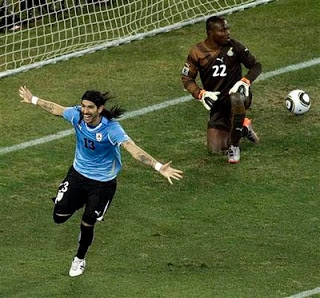
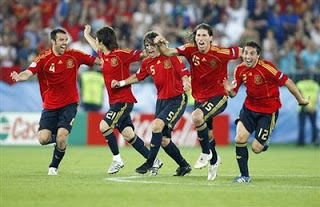 Pepping and his research group (Moll, Jordet, & Pepping, 2010) studied a large number of penalty shootouts during important soccer matches, but only as long as the score in the shootout was still equal. After every shot at goal, the player was assessed on the degree to which he expressed happiness and pride after scoring. This revealed that the players who expressed this clearly, for example by throwing their arms up into the air, usually belonged to the winning team. "This enthusiastic behaviour infected the team with a positive attitude. Also important, the opposing team was made to feel that little bit more insecure." In the study this latter effect was shown by the finding that when someone cheered with both arms in the air, it was more than twice as likely that the next opponent would miss his penalty.
What's very important is that the scored goal is celebrated with the people you want to infect. Pepping: "If you cheer facing the supporters after you've scored a penalty, the supporters will get wildly enthusiastic. That's all very fine, but they're not the ones who have to perform at that moment. Your team members on the pitch are. It's very important to celebrate together -- that's what makes scoring contagious."
Motivating each other
The same principle is easy to project onto situations outside the sports field, according to Pepping. Even in an office situation you can motivate each other by dwelling on a good group performance and celebrating it with each other. That means that the whole team will share the feelings of pride and confidence, which raises performance levels. However, you should be careful not to exaggerate by taking the expressions of happiness or pride out of context, according to Pepping.
In some countries people tend to react to success in a less heated way than in in others. "In the Netherlands many people seem to have forgotten how to react exuberantly." According to Pepping, if you want to increase your chances of success, both on the sports field and in daily life, it's important to 'take the brakes off'. It's natural to cheer in reaction to a victory. What's more, as revealed by the research, when individual and group interests coincide it's also a very functional reaction. More cheering means more success.
Source: University of Groningen and Tjerk Moll, Geir Jordet, Gert-Jan Pepping. Emotional contagion in soccer penalty shootouts: Celebration of individual success is associated with ultimate team success. Journal of Sports Sciences, 2010; : 1 DOI: 10.1080/02640414.2010.484068
See also: Kicking Style Of Women Soccer Players May Cause Injury and Goalkeepers Use Clues To Guess Direction Of Penalty Kick