Soccer Referees Biased Against Tall Players
/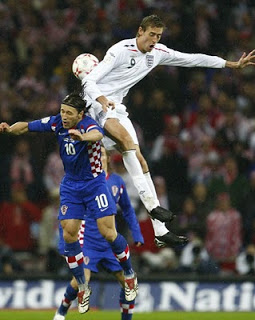
Dr. Niels van Quaquebeke and Dr. Steffen Giessner, scientists at Rotterdam School of Management, Erasmus University began their research by transferring their insights from decision making in business into the arena of sports. Specifically, they wanted to investigate whether people consider the available information in such ambiguous foul situations in an unbiased, i.e. subconsciously unprejudiced, way.
Based on evolutionary and linguistic research which has revealed that people associate the size of others with concepts such as aggression and dominance, Van Quaquebeke and Giessner speculated that ambiguous fouls are more likely to be attributed to the taller of two involved players. Results indicate that respectively taller people are more likely to be perceived by referees (and fans!) as foul perpetrators and their respectively smaller opponents as foul victims.
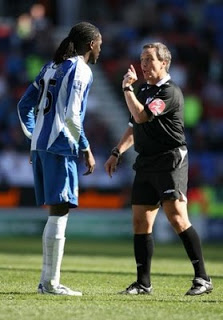 To put their assumption to a test, the scientists analysed all fouls recorded by Impire AG in seven seasons of UEFA Champions League (32,142 fouls) and German Bundesliga (85,262 fouls), the last three FIFA World Cups (6,440 fouls) as well as data from two additional perceptual experiments with football fans. For all seasons, leagues, and data collection methods, their analyses revealed the same picture confirming their initial assumption: taller people are indeed more often held accountable for fouls than shorter ones -- even when no actual foul was committed.
An article based on their research will be published in the Journal of Sport & Exercise Psychology in February 2010.
Van Quaquebeke said, "We chose football as the context of our studies because the sport often yields ambiguous foul situations in which it is difficult to determine the perpetrator. In such situations, people must rely on their 'instincts' to make a call, which should increase the use and thus the detectability of a player's height as an additional decision cue. Furthermore, the use of referee assistance technology and adequate referee training is frequently debated in association football. Thus, by providing scientific insights on potential biases in refereeing, our work might help officials weigh the options."
Both researchers say, however, that it is not their call how to derive conclusions for football practice.
Sources: Erasmus University Rotterdam and "How embodied cognitions affect judgments: Height-related attribution bias in football foul calls"