Cristiano Roboto - The Soccer Playing Robot


Back in April, 80 teams of researchers from 15 countries got together to compete in the 2008 RoboCup German Open, a soccer tournament where the "athletes" are all totally autonomous robots like the one pictured above. Four players and a goalkeeper per team play on a 20x14 meter field and are independent of any human remote control. They need to have sub-systems that "see" the field, opponents and the goal; have locomotion logic to move forward, sideways and back; some tactical logic to sense an opponent and avoid "it"; and targeting to kick the ball in the direction of the goal.

You can see some brief clips of the robots on the pitch here. Try the second video to see the most game highlights. The discussion is in German, if any of you speak it, but the game clips are what to focus on.

The more practical future applications of these sub-systems is to program robots to do more meaningful tasks like search and rescue operations in dangerous areas, (fire, earthquake, enemy zones), using the same visual, locomotion, search algorithms that guide the robot on the soccer field. In fact, there is a RoboRescue competition as well.

What struck me most about watching these robots was the complexity of the logic that needs to be programmed. The visual system that must learn the field, the sidelines, the dimensions of the goal, the difference between a teammate and an opponent. The tactical system that must be "goal" directed, (pun intended). It must learn that the object of the game is to put the ball into the opponent's goal and stop the ball from entering your own goal.

The constant motion sensor to understand where they are on the field, when to dribble, when to stop, when to aim and when to kick. The researchers/programmers in this competition are some of the brightest minds in the world, yet when you watch the video, you might have the same reaction that I did; that this is an impressive start, but they still look rather rudimentary.

Thinking about the topics we cover here, we often take for granted all of the logic and skills that human athletes demonstrate every day. I'm thinking especially of our kids that can easily surpass the performance of these robots, even as young as 3 years old. My fascination, and probably these researchers, is HOW we are able to do these tasks so easily. If we understand more about the "how", then we can also design better practice environments to advance those skills even faster.
Source: Fraunhofer-Gesellschaft (2008, April 4). Soccer Robots Compete For The Title. ScienceDaily. Retrieved May 29, 2008, from http://www.sciencedaily.com/releases/2008/04/080401110128.htm#

A Keeper's Nightmare - Beckham, Ronaldo or Juninho

ResearchBlogging.org

Whether you bend it like Beckham or Ronaldo or Juninho or even Nakamura; the curving free kick is one of the most exciting plays in soccer/football. Starting with Rivelino in the 1970 World Cup and on to the specialists of today, more players know how to do it and understand the basic physics behind it, but very few can perfect it. But, when it does happen, by chance or skill, it is the highlight of the game.

But let's take a look at this from the other side, through the eyes of the goalkeeper. Obviously, its their job to anticipate where the free kick is going and get to the spot before the ball crosses the line. He sets up his wall to, hopefully, narrow the width of the target, but he knows some players are capable of bending the ball around or over the wall towards the near post. If you watch highlights of free kick goals, you often see keepers flat-footed, just watching the ball go into the top corner. Did they guess wrong and then were not able to react? Did they guess right but misjudged the flight trajectory of the ball. How much did the sidespin or "bend" affect their perception of the exact spot where the ball will cross the line?

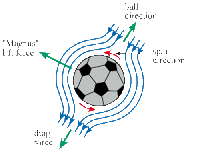
Researchers at Queen's University Belfast and the University of the Mediterranean in France tried to figure this out in this paper. They wanted to compare the abilities of expert field players and expert goalkeepers to accurately predict if a free kick would result in an on-target goal or off-target non-goal. First, a bit about why the ball "bends". We can thank what's called the "Magnus Force" named after the 19th-century German physicist Gustav Magnus. As seen in the diagram below, as the ball spins counter clockwise (for a right-footed player using his instep and kicking the ball on the right side), the air pressure on the left side of the ball is lower as the spin is in the same direction as the oncoming air flow. On the right side of the ball, the spin is in the opposite direction of the air flow, building higher pressure. The ball will follow the path of least resistance, or pressure, and "bend" or curve from right to left. The speed of the spin and the velocity of the shot will determine the amount of bend. For a clockwise spin, the ball bends from left to right.


The researchers showed the players three different types of simulated kicks, a kick bent to the right, a kick bent to the left and a kick with no spin at all. They showed the players these simulations with virtual reality headsets and computer controlled "kicks" and "balls" which they could vary in flight with different programming. The balls would disappear from view at distances of 10 and 12.5 meters from the goal. The reasoning is that this cutoff would correspond with the deadline for reaction time to make a save on the ball. In other words, if the keeper does not correctly guess the final trajectory and position of the ball by this point, he most likely will not be able to physically get to the ball and make the save.

The results showed that both the players and the keepers, (all 20 were expert players from elite clubs like AC Milan, Marseille, Bayer LeverkusenSchalke 04), were able to correctly predict the result of the kicks with no spin added. However, as 600 RPM spin, either clockwise or counter-clockwise, was added to the ball, the players success declined significantly. Interestingly, the keepers did no better, statistically, then the field players. The researchers conclusion was that the players used the "current heading direction" of the ball to predict the final result, rather than factoring the future affect of the acceleration and change in trajectory caused by the spin.

Game Highlights
Just as we saw in the Baseball Hitting post, our human perception skill in tracking flying objects, especially those that are spinning and changing direction, are not perfect. If we understand the physics of the spinning ball and we can better guess at its path, but the pitcher or the free kick taker doesn't usually offer this information beforehand! In the next few posts, I'll be looking at a related topic in perception; a concept known as "Quiet Eye", developed by Prof. Joan Vickers. Check back as this is one of the best applications of cognitive science in sports that I have seen.

Source:
Craig, C.M., Berton, E., Rao, G., Fernandez, L., Bootsma, R.J. (2006). Judging where a ball will go: the case of curved free kicks in football. Naturwissenschaften, 93(2), 97-101. DOI: 10.1007/s00114-005-0071-0

Baseball and the Brain - Fielding

With the crack of the bat, the ball sails deep into the outfield. The left-fielder starts his run back and to the right, keeping his eyes on the ball through its flight path. His pace quickens initially, then slows down as the ball approaches. He arrives just in time to make the catch. What just happened? How did this fielder know where to run and at what speed so that he and the ball intersected at the same exact spot on the field. Why didn't he sprint to the landing spot and then wait for the ball to drop, instead of his controlled speed to arrive just when the ball did? What visual cues did he use to track the ball's flight (just the ball? the ball's movement against its background? other fielder's reaction to the ball?)

Just like we learned in pitching and hitting, fielding requires extensive mental abilities involving eyes, brain, and body movements to accomplish the task. Some physical skills, such as speed, do play a part in catching, but its the calculations and estimating that our brain has to compute that we often take for granted. The fact that fielders are not perfect in this skill, (there are dropped fly balls, or bad judgments of ball flight), begs the question of how to improve? As we saw with pitching and hitting (and most sports skills), practice does improve performance. But, if we understand what our brains are trying to accomplish, we can hopefully design more productive training routines to use in practice.

(Mike Stadler, associate professor of psychology at University of Missouri, provides a great overview of current research in his book, "The Psychology of Baseball". I highly recommend it for the complete look at this topic. I'll summarize the major points here.)

One organization that does not take this skill for granted is NASA. The interception of a ballistic object in mid-flight can describe a left fielder's job or an anti-missile defense system or how a pilot maneuvers a spacecraft through a three dimensional space. In fact, a postdoctoral fellow at the NASA Ames Research Center, Michael McBeath , has been studying fly ball catching since 1995. His team has developed a rocket-science like theory named Linear Optical Trajectory to describe the process that a fielder uses to follow the path of a batted ball. LOT says the fielder will adjust his movement towards the ball so that its trajectory follows a straight line through his field of vision. Rather than compute the landing point of the ball, racing to that spot and waiting, the fielder uses the information provided by the path of the ball to constantly adjust his path so that they intersect at the right time and place. The LOT theory is an evolution from an earlier theory called Optical Acceleration Cancellation (OAC) that had the same idea but only explained the fielder's tracking behavior in the vertical dimension. In other words, as the ball leaves the bat the fielder watches the ball rise in his field of vision. If he were to stand still and the ball was hit hard enough to land behind him, his eyes would track the ball up and over his head, or at a 90 degree angle. If the ball landed in front of him, he would see the ball rise and fall but his viewing angle may not rise above 45 degrees. LOT and OAC argue that the fielder repositions himself throughout the flight of the ball to keep this viewing angle between 0 and 90 degrees. If its rising too fast, he needs to turn and run backwards. If the viewing angle is low, then the fielder needs to move forward so that the ball doesn't land in front of him. He can't always make to the landing spot in time, but keeping the ball at about a 45 degree angle by moving will help ensure that he gets there in time. While OAC explained balls hit directly at a fielder, LOT helps add the side-to-side dimension, as in our example of above of a ball hit to the right of the fielder.

The OAC and LOT theories do agree on a fundamental cognitive science debate. There are two theories of how we perceive the world and then react to it. First, the Information Processing (IP) theory likens our brain to a computer in that we have inputs, our senses that gather information about the world, a memory system that stores all of our past experiences and lessons learned, and a "CPU" or main processor that combines our input with our memory and computes the best answer for the given problem. So,IP would say that the fielder sees the fly ball and offers it to the brain as input, the brain then pulls from memory all of the hundreds or thousands of fly ball flight paths that have been experienced, and then computes the best path to the ball's landing point based on what it has "learned" through practice. McBeath's research and observations of fielders has shown that the processing time to accomplish this task would be too great for the player to react. OAC and LOT subscribe to the alternate theory of human perception, Ecological Psychology (EP). EP eliminates the call to memory from the processing and argues that the fielder observes the flight path of the ball and can react using the angle monitoring system. This is still up for debate as the IPers would argue "learned facts" like what pitch was thrown, how a certain batter hits those pitches, how the prevailing wind will affect the ball, etc. And, with EP, how can the skill differences between a young ballplayer and an experienced major leaguer be accounted for? What is the point of practice, if the trials and errors are not stored/accessed in memory?

Of course, we haven't mentioned ground balls and their behavior, due to the lack of research out there. The reaction time for a third baseman to snare a hot one-hopper down the line is much shorter. This would also argue in favor of EP, but what other systems are involved?

Game Highlights
Again, I have just touched on this subject, see Prof. Stadler's book for a much better discussion. Arguing about which theory explains a fielder's actions is only productive if we can apply the research to create better drills and practices for our players. My own layman's view is that the LOT theory is getting there as an explanation, but I'm still undecided about EP vs. IP . So many sport skills rely on some of these foundations, hence my "search for the truth" continues! As with pitching and hitting, fielding seems to improve with practice. As we move forward, we'll look at the theories behind practice and what structure they should take.


Baseball and the Brain - Hitting

Ted Williams, arguably the greatest baseball hitter of all-time, once said, "I think without question the hardest single thing to do in sport is to hit a baseball". Certainly, at the major league level, where pitches can reach 100 miles per hour, this is believable, but even at Little League, High School and College/Minor leagues, the odds are against the hitter. Looking at batting averages, 3 hits out of 10 at-bats will earn a player millions of dollars in the bigs, while averaging 4 or 5 hits out of 10 at the lower leagues will earn you some attention at the next level. As most of you know, Williams was the last major league player to hit .400 for an entire season and that was back in 1941, almost 67 years ago! In my second of three posts of the Baseball and the Brain series, we'll take a quick look at some of the theory behind this complicated skill.

Again, my main reference for these ideas is "The Psychology of Baseball" by Mike Stadler.


Some questions that come to mind regarding hitting a pitched baseball:
- What makes this task so hard? Why can't players, who practice for years and have every training technique, coach and accumulated knowledge at the
ir disposal, perform at a consistenly higher level?
- What can be improved? Hand-eye reaction time? Knowledge of situational tendencies (what pitch is likely to be thrown in a given game situation)?

A key concept of pitching and hitting in baseball was summed up long ago by Hall of Fame pitcher Warren Spahn, when he said,
“Hitting is timing. Pitching is upsetting timing.” To sync up the swing of the bat with the exact time and location of the ball's arrival is the challenge that each hitter faces. If the intersection is off by even tenths of a second, the ball will be missed. As was discussed in the Pitching post, the hitter must master the same two dimensions, horizontal and vertical. The aim of the pitch will affect the horizontal dimension while the speed of the pitch will affect the vertical dimension. The hitter's job is to time the arrival of the pitch based on the estimated speed of the ball while determining where, horizontally, it will cross the plate. The shape of the bat helps the batter in the horizontal space as its length compensates for more error, right to left. However, the narrow 3-4" barrel does not cover alot of vertical ground. So, a hitter must be more accurate judging the vertical height of a pitch than the horizontal location. So, if a pitcher can vary the speed of his pitches, the hitter will have a harder time judging the vertical distance that the ball will drop as it arrives, and swing either over the top or under the ball.

A common coach's tip to hitters is to "keep your eye on the ball" or "watch the ball hit the bat". As Stadler points out in his book, doing both of these things is impossible due to the concept known as "angular velocity". Imagine you are standing on the side of freeway with cars coming towards you. Off in the distance, you are able to watch the cars approaching your position with re
lative ease, as they seem to be moving at a slower speed. As the cars come closer and pass about a 45 degree angle and then zoom past your position, they seem to "speed up" and you have to turn your eyes/head quickly to watch them. This perception is known as angular velocity. The car is going a constant speed, but appears to be "speeding up" as it passes you, because your eyes need to move more quickly to keep up. This same concept applies to the hitter. The first few feet that a baseball travels when it leaves a pitcher's hand is the most important to the hitter, as the ball can be tracked by the hitter's eyes. As the ball approaches past a 45 degree angle, it is more difficult to "keep your eye on the ball" as your eyes need to shift through many more degrees of movement. Research reported by Stadler shows that hitters cannot watch the entire flight of the ball, so they employ two tactics. First, they might follow the path of the ball for 70-80% of its flight, but then their eyes can't keep up and they estimate or extrapolate the remaining path and make a guess as to where they need to swing to have the bat meet the ball. In this case, they don't actually "see" the bat hit the ball. Second, they might follow the initial flight of the ball, estimate its path, then shift their eyes to the anticipated point where the ball crosses the plate to, hopefully, see their bat hit the ball. This inability to see the entire flight of the ball to contact point is what gives the pitcher the opportunity to fool the batter with the speed of the pitch. If a hitter is thinking "fast ball", their brain will be biased towards completing the estimated path across the plate at a higher elevation and they will aim their swing there. If the pitcher actually throws a curve or change-up, the speed will be slower and the path of the ball will result in a lower elevation when it crosses the plate, thus fooling the hitter.

Game Summary
As in pitching, our eyes and brain determine much of the success we have as hitters. We took a quick look as it relates to hitting a baseball, but the same concepts apply to hitting any moving object; tennis, hock
ey, soccer, etc. In future posts, we'll look at practical ways to improve this tracking skill and the hand/eye/brain connection. As usual, practice will improve performance, but we want to identify the unique practice techniques which will be most effective. Tracking a moving object also applies to catching, which we'll look at next.

Baseball and the Brain - Pitching

As promised, we begin our look at the three most important technical skills of baseball: Pitching, Hitting and Catching. Each of these skills apply to other sports as well, but I thought we'd stick with the current season of baseball as the sport du jour. Again, my focus for "80 Percent Mental" is to look at sports cognition in a generic sense across all sports, occasionally digging deeper into individual sport specialties. The practical side of this is to understand how our brains and nervous system perform these skills that we often take for granted, so that we can brainstorm (yuk-yuk) on new ways to teach, practice and perfect these skills.

Pitching/Throwing
Pitching a 3" diameter baseball 46 feet (for Little League) or 60 feet, 6 inches over a target that is 8 inches wide requires an accuracy of 1/2 to 1 degree. Throwing it fast, with the pressure of a game situation makes this task one of the hardest in sports. In ad
dition, a fielder throwing to another fielder from 40, 60 or 150 feet away, sometimes off balance or on the run, tests the brain-body connection for accuracy. So, how do we do it? And how can we learn to do it more consistently?

Questions that come to my mind regarding pitching/throwing skills and baseball include:
- Why
can't a pitcher control ALL of his/her pitches? Why do some not only miss the strike zone, but are wild?
- Is the breakdown physical in the muscle sequence of the throw or is it in the connection between eyes, brain and body?

Again, one the best references I have found on this is "The Psychology of Baseball" by Mike Stadler, published by Gotham Books. Prof. Stadler digs into many of these topics and I will paraphrase from his findings. I won't do it justice here, so please put it on your reading list.

There are two dimensions to think about when throwing an object at a target: vertical and horizontal. The vertical dimension is a function of the distance of the throw and the effect of gravity on the object. So the thrower's estimate of distance between himself and the target will determine the accuracy of the throw vertically. Basically, if the distance is underestimated, the required strength of the throw will be underestimated and will lose the battle with gravity, resulting in a throw that will be either too low or will bounce before reaching the target. An example of this is a fast ball which is thrown with more velocity, so will reach its target before gravity has a path-changing effect on it. On the other hand, a curve ball or change-up may seem to curve downward, partly because of the spin put on the ball affecting its aerodynamics, but also because these pitches are thrown with less force, allowing gravity to pull the ball down. In the horizontal dimension, the "right-left" accuracy is related to more to the "aim" of the throw and the ability of the thrower to adjust hand-eye coordination along with finger, arm, shoulder angles and the release of the ball to send the ball in the intended direction.

So, looking at our first question, how do we improve accuracy in both dimensions? Prof. Stadler points out that research shows that skill in the vertical/distance estimating dimension is more genetically determined, while skill horizontally can be better improved with practice. Remember those spatial organization tests that we took that show a set of connected blocks in a certain shape and then show you four more sets of conected blocks? The question is which of the four sets could result from rotating the first set of blocks. Research has shown that athletes that are good at these spatial relations tests are also accurate throwers in the vertical dimension. Why? The thought is that those athletes are better able to judge the movement of objects through space and can better estimate distance in 3D space. Pitchers are able to improve this to an extent as the distance to the target is fixed. A fielder, however, starts his throw from many different positions on the field and has more targets (bases and cut-off men) to choose from, making his learning curve a bit longer.

If a throw or pitch is off-target, then what went wrong? Prof. Stadler collects many different studies that review the possible physiological/mechanical reasons for "bad throws". Despite all of the combinations of fingers, hand, arm, shoulder and body movements, it seems to all boil down to the timing of the finger release of the ball. In other words, when the pitcher's hand comes forward and the fingers start opening to allow the ball to leave. The timing of this release can vary by hundredths of a second but has significant impact on the accuracy of the throw. But, its also been shown that the throwing action happens so fast, that the brain could not consciously adjust or control that release in real-time. This points to the throwing action being controlled by what psychologists call an automated "motor program" that is created through many repeated practice throws. But, if a "release point" is incorrect, how does a pitcher correct that if they can't do so in real-time? It seems they need to change the embedded program by more practice.

Another component of "off-target" pitching or throwing is the psychological side of a player's mental state/attitude. Stadler identifies research that these motor programs can be called up by the brain by current thoughts. There seems to be "good" programs and "bad" programs, meaning the brain has learned how to throw a strike and learned many programs that will not throw a strike. By "seeding" the recall with positive or negative thoughts, the "strike" program may be run, but so to can the "ball" program. So, if a pitcher thinks to himself, "don't walk this guy", he may be subconsciously calling up the "ball" program and it will result in a pitch called as a ball. So, this is why sports pscyhologists stress the need to "think positively", not just for warm and fuzzy feelings, but the brain may be listening and will instruct your body what to do.

Game Summary
I've only touched the surface for this topic. We'll see some of these themes in the hitting and catching posts that are coming up. One useful takeaway here for youth coaches is that some players will have a genetic advantage in throwing and may be your "natural" pitchers. As we dig deeper into these topics, we will be able pull out more practical tips for players and coaches.

Baseball and the Brain

Its April, so that means baseball diamonds all over the country are filling up with teams getting ready for another season. Pitching, fielding and batting skills are being tested, evaluated and trained. So, this is a logical place to start to dig into the theory, teachings and tips of three of the technical skills area I mentioned in the Sports Cognition Framework. As I've mentioned before, I'm learning as I go and rely heavily on the books and papers I read on these topics. This look at baseball is no exception.
At the top of my baseball list is "The Psychology of Baseball" by Mike Stadler, published by Gotham Books. Mike, an associate professor of cognitive psychology at the University of Missouri, does a great job of combining baseball stories with the cognitive theories used to explain his favorite sport. I highly recommend it.
Here's my game plan for this "World Series" of posts:
Part 1 - Pitching/Throwing: Pitching a 3" diameter baseball 46 feet (for Little League) or 60 feet, 6 inches over a target that is 8 inches wide requires an accuracy of 1/2 to 1 degree. Throwing it fast, with the pressure of a game situation makes this task one of the hardest in sports. In addition, a fielder throwing to another fielder from 40, 60 or 150 feet away, sometimes off balance or on the run, tests the brain-body connection for accuracy.
Part 2 - Hitting: As Ted Williams claimed many times, hitting a baseball thrown at 90+ MPH that may dip, curve or go in a straight line is "the hardest" sport skill in sports. As we'll see, its all about estimating speed and timing, with calculations far too difficult to be consciously calculated in the very short window of time between the pitcher's release and the ball crossing the plate (.4 to .6 seconds)
Part 3 - Fielding: Before the right fielder can make that deadly accurate throw to third base to nab the runner, he must first catch the flyball hit 50 feet to his right and slightly behind, with a swirling wind changing the fight path of the ball, while running across the field while keeping his eyes on the ball. Again, the eye-brain-muscular connection must make on the fly calculations to get that glove in the exact spot where the ball will land. Most of the time it seems so routine that we don't think of the effort involved. Other times, we are amazed at how a major league player, who has caught thousands of fly balls in his life can make the occassional error. Of course, at the Little League level, errors are more common. We'll learn that practice does improve performance over time, I would like to know how. And, once we understand the learning process, can we design better practices and teach better techniques to speed up that player's skill level.

What is the Toughest Sport to Play?

Ask any athlete, weekender or pro, which sport requires the most overall skill and talent to play and you would get many different answers. It depends on the mix of "skills" used in the comparison. Are we talking raw physical skills like speed and power, technical skills like throwing and catching or mental skills like determination and nerve? The debate could be endless, as there would be apples to oranges comparisons, but its worth a look. ESPN, of all people, took this challenge head-on and actually put together a reasonable survey of experts, (OK, some of whom were ESPN'ers), to rank the 60 sports along 10 different criteria. Check it out at the ESPN site here .
The surprising result was that boxing, the sweet science, ranked number one, edging out hockey but comfortably ahead of football and basketball. Again, the analysis is across all 10 variables, and boxing scored in the top 5 in five different categories: Endurance, Strength, Power, Nerve and Durability. Of course, boxing ranks low in Speed, Agility and Flexibility. But, I know my reaction to boxing's top spot was probably similar to most others: Two strong guys bashing each other until they drop to the ground or until its over, which then would be decided by judges on who did the most bashing. In other words, I don't have the proper respect for the sport that apparently I should.
What really intrigues me about these rankings are the categories themselves and the ability to sort the list of sports by each category. There are the "brainy sports", hockey, auto racing(!) and soccer, rated high in Analytic Aptitude. Baseball and tennis score high in the "technical skill" of Hand-Eye Coordination. In the "positive mental state" group are those sports that score high in Endurance, Durability, and what the survey calls Nerve, or the ability to overcome fear. Sports high in this group include the "long distance" sports of cycling, running and swimming; the "tough guy" sports of boxing, football, hockey and rugby; and the "no fear" sports of auto racing, rodeo, alpine skiing and boxing.
Take a look at the table they have listed. Its fun to sort on different columns and then think through the logic. Let me know if you agree or disagree with the "experts"!

The Map of Sport Skills

One of the most common sense categorizations of sport skills that I have run across is from Successful Coaching, 3rd Edition by Rainer Martens. By the way, I highly recommend this book as a complete reference to the basics of coaching. On page 182-3, The "Celestial Map of Sport Skill" shows six areas that an athlete has to develop to be a complete player. I'll paraphrase them here:

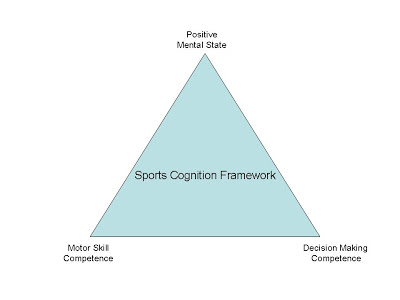
Technical Skills - similar to the "Motor Skill Competence" that I list in the Sports Cognition Framework (SCF), these are the generic sport skills that cross several different sports:
- Hitting
- Fielding
- Shooting
- Passing
- Kicking
- Guarding
- Throwing
- Running
- Jumping

Tactical Skills - like "decision-making ability" referenced in the SCF, these are the "in-game" abilities to choose the right thing to do in different scenarios
- Rules of the game
- Reading the situation
- Situation tactics
- Self awareness of skills
- Game plan and strategy
- Decision-making skills

Mental Skills - "Positive Mental State" in the SCF, these skills make up the emotional and motivational state of the athlete. Often included in the field of Sport Psychology
- Motivation
- Emotional control
- Concentration
- Confidence

Physical Skills - this set of skills is the raw athletic skills that are needed to perform the technical skills
- Speed
- Power
- Flexibility
- Quickness
- Balance
- Agility
- Strength
- Acceleration
Character - to build a complete athlete and person, these skills are necessary
- Respect
- Fairness
- Honesty
- Responsibility
- Leadership

As I have mentioned previously, my focus in this blog will be on the first three skill sets, leaving Physical Skills to the many practitioners and exercise facilities for athletes and Character to other life-learning environments.

The Sports Cognition Framework


So, why should athletes and coaches be interested in all of this cognitive science stuff? They have been playing and coaching these sports for years, practicing with the same drills and routines and having success. Some may say, "if it ain't broke..." At the same time, all players and coaches are looking for the "the Edge"; the practice technique, game strategy, player development skill that will help the bottom line; winning. The physical training attributes still need to be developed in terms of raw speed, acceleration, agility, strength and balance. Hours are spent in the training rooms and gyms improving these variables. The game preparation process is still there; watching film, breaking down strengths and weaknesses of the opponent, tactical planning, etc. Some may say that is the "mental preparation" needed for competition. That's true, it is a plan for success, but the key is in execution of the plan. At the exact moment in the game when execution is needed, will each player know the right thing to do and be able to do it? That is the essence of what I call the "Sports Cognition Framework". It is the combination of the three themes: decision-making competence (knowing what to do), motor skill competence (being physically able to do it), and positive mental state (being motivated and confident to do it). There seem to be many, deep areas of research into each of these topics. My job is to dig into each of these areas and look for relevant research that you will find practical to include in your training or your coaching.

Where Does Sport Psychology Fit?

As I outline my framework for researching the neuro-motor skills necessary for sports, I have debated where the discipline of "sport psychology" fits. Obviously, the topics of motivation, fear, anxiety, concentration, imagery and leadership are critical to the success of any athlete, and are often included under the heading of sport psychology. I can see more application of these ideas in the realm of decision theory than the core skills. An athlete does not perform in a vacuum. His decisions on the field are affected by his emotions, his confidence level, his fear of failure. For example, what effect does the game situation have on a pitcher's skill level? If the score is 0-0, with no one on base and 2 outs in the first inning, not only will his pitch selections and execution be determined by his rational, tactical decisions, but also by his confidence level at that point. Did his last outing go well? Has he had a good month of starts, or is he nervous about getting through this game? Athletes are humans, not robots. Their confidence, motivation and emotions cannot be detached from their skills. The degree to which they can keep their feelings under control are a measure of their maturity as a player but all athletes are somewhere along the continuum. Based on this assumption, we will definitely dig into this "emotional intelligence", to borrow the phrase from Daniel Goleman, but will separate the topics initially and address their intersection later.

What Was He Thinking? Decision Theory in Sports


Previously, I outlined the core framework of sports skills. Over time, my intention is to dive deep into each of those areas and present research that will be useful to you in understanding the brain-body connection. Again, the goal of my ramblings here is to examine the foundation of skills necessary to perform well across the continuum of most sports. Ongoing posts will use this framework to organize this information into categories that are easy to search and focus on what you are interested in that day.

In addition to the core skills, there seems to be another equally significant side of sports cognition known as "decision theory". There is a deep research base in this area, not only specific to sports, but across other platforms (i.e. business, medicine, etc.) Basically, the application in sports looks at how athletes make thousands of split-second decisions during a game, some which will go unnoticed, but some that will affect the outcome. While most of these decisions appear instant and somewhat random, are there layers of "conditioning" that trigger one response versus another? Let's look at some examples:
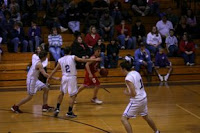
Situation 1: Mike brings the basketball up the floor during a game and makes a pass to Tom. How many factors affected Mike's decision about that pass?
- Tom appeared to be "open".
- The play that the coach called dictated that Mike pass first to Tom.
- The game was tied and time was running out, and Mike knew Tom was the best option to score.
- Mike knew that Jack, another teammate, had missed his last 5 shots and wanted to avoid giving him the ball.
- Mike had missed his last 5 shots and was afraid to shoot.
- Mike and Tom are friends and feel the rest of the team is not at their skill level.
- Mike's choice was completely random
- Is there a "correct" answer, and if not, how do we judge effectiveness of the decision?

Situation 2: Mary is playing centerfield for her softball team. There are runners on 1st and 2nd base and there is 1 out. A ground ball is hit to her, she fields the ball and now needs to make a throw to a base. How does she decide where to throw?
- What is her "pre-pitch" analysis of the game situation? Does she have a plan of where to throw?
- What is the score of the game? Does she need to prevent a run from scoring?
- What is her self-assessment of her throwing ability? Does she have confidence in her throw to any base?
- What does her visual information give her during the play? When she fields the ball and looks up, what are her eyes telling her about the changing position of the runners?
- What are her teammates and coaches instructing (yelling at) her to do?
- Is there a "correct" answer?

To me, this side of the "80% mental" equation is just as important to success in sports. It deserves alot of attention and understanding, before we can coach athletes on how to improve these decision making skills. We will add this to our outline of research.

Sorting the Skill Sets


OK, so before I take on the whole world of cognitive psychology, kinesiology, neuromuscular patterns and the motor skill development (yikes!), I want to try to categorize the different distinct set of skills that seem obvious to my untrained eye. While each sport is different in its rules, objectives and layout, the underlying skills required of the athletes seem to overlap. My early theory is that if athletes, especially young athletes, focus on the fundamentals of each core skill set, then they will be able to transfer those "mental maps" to other sports. Also, when considering the pieces necessary to perform a skill, it will be easier to break down the variations of the skill of each sport and get to the underlying mechanics.

So, here is my "Outline of Sport Skills" that will help organize our research and discovery:

First, a definition from Merriam-Webster (M-W.com) of skill: the ability to use one's knowledge effectively and readily in execution or performance b: dexterity or coordination especially in the execution of learned physical tasks

Throwing (M-W.com: to propel through the air by a forward motion of the hand and arm) Sample sports: baseball, football, cricket, basketball, bowling, etc.
One qualifier that I would add is to throw "at a target", which would differ than just throws for distance (i.e. shot/discus/javelin). The skill is two-dimensional as it involves judgment of distance and lateral accuracy.
Research questions would include:
- How is distance to target determined?
- How is lateral accuracy determined? (i.e. right-left, up-down target accuracy)
- If we include a soccer kick in this category, how are foot-eye coordination different than hand-eye?

Catching (M-W.com:
to grasp and hold on to (something in motion)) Sample sports: baseball, football, cricket, basketball, hockey, etc.
As familiar as we are with the act of catching a ball, we rarely dig deep into the true skill involved.
Research questions would include:
- How does the athlete judge the flight of the object (ball)?
- What are the visual cues that we use to reposition ourselves to meet the object at the right place and time to make the catch?
- What tactile cues to we use to close the grasp on the object?

Hitting (M-W.com:
to strike (as a ball) with an object (as a bat, club, or racket) so as to impart or redirect motion) Sample sports: baseball, golf, tennis, hockey, etc.
There are two variations: hitting a stationary (golf) vs. a moving object (baseball, tennis, hockey, cricket)
Research questions would include:
- Are the object tracking skills of Catching similar to those needed in Hitting?
- How does the neuro-motor connection adjust to the use of an object?

These three sets of skills cover most of the necessary situations in most major "goal-oriented" sports as opposed to the repetitive action sports of running, swimming, cycling, etc. Learning the commonalities at a very basic level should offer ideas of how to improve these core abilities through exercises and techniques.

The Beginning...

First off, thanks for stopping by! I hope you can find some useful information here. There's over 200 articles on sports science, sports psychology, fitness research and the science of coaching from the last 3 years. Its kind of an unusual mix of stuff, but it is a collection of topics that all revolve around the mental side of sports.

For many years, I have had an interest in cognitive science and sports science. More specifically, how do we learn to perform all of the individual motor skills necessary to compete in any type of sports? Why do some athletes outperform others? Why can't all basketball players make 95% of their free throws?  Why do athletes make "mental errors" or "poor decisions" during a game or competition?

Finding answers to these questions is the fun part for me and I'm happy to share what I learn with you.

I hope that Sports Are 80 Percent Mental becomes the community hub for coaches, scientists, parents and athletes of all ages.

Also, I report on cognitive science and sports performance research for Axon Sports.  Please visit them to learn more about how athletes can Train Above The Neck.

If you have questions or topics for me, please just let me know and I'll be happy to add them to my future stories.

For any scientists or authors, if you have an article or book that you would like to get in front of our readers, just drop me a message.  I'd be happy to help.

Again, I really appreciate your time here and hope it's worthwhile!

Dan Peterson
E-mail: dan@80percentmental.com
Please follow me at: twitter.com/DanielPeterson
or on Facebook | Sports Are 80 Percent Mental